Why Is Personalized Learning Important?
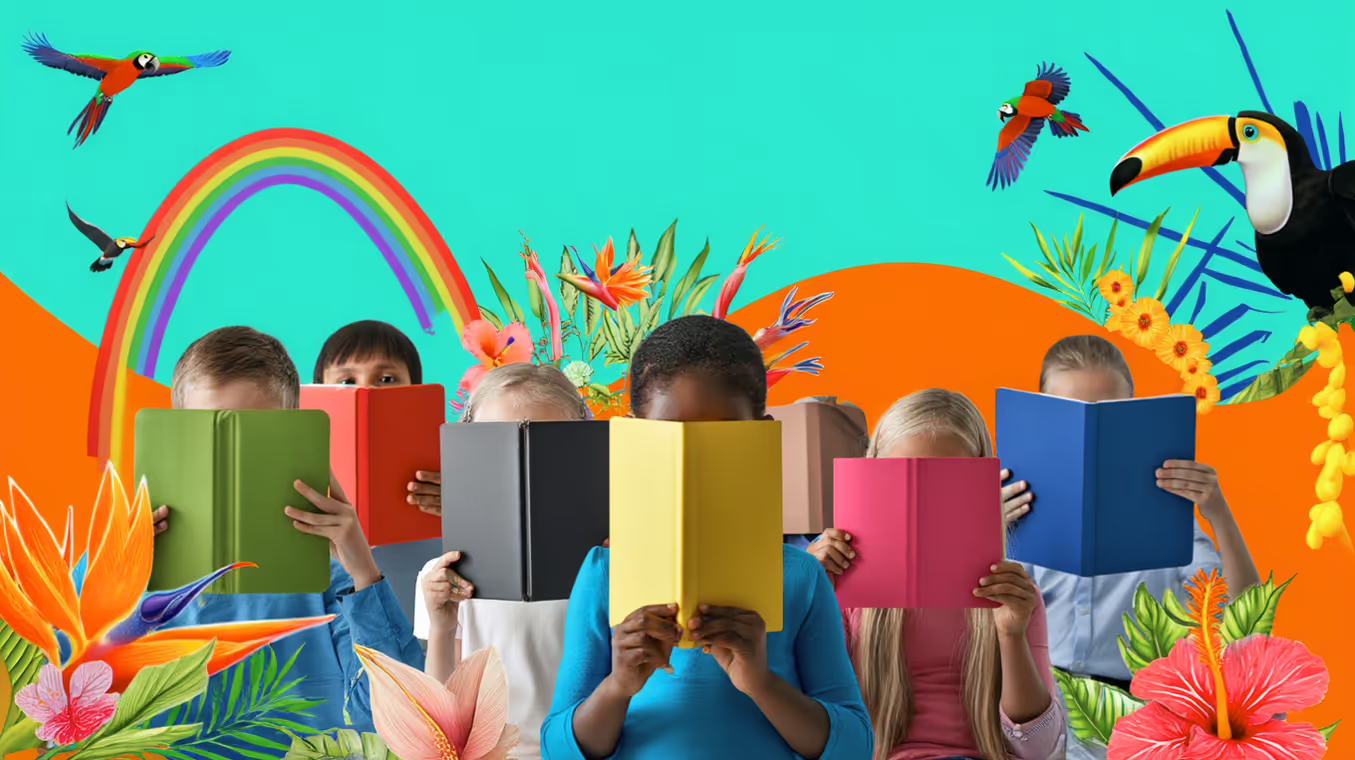
Every child is made up of their own special mix of dreams, talents, and needs, but most schools teach as if all kids moved to the beat of the same drummer. In reality, some kiddos race through math problems, while others struggle to stay focused. Some absorb science with a worksheet and a lecture; others need more hands-on learning to make things click.
This learning diversity is why taking a personalized approach is so important. School shouldn’t be one-size-fits-all. Being open and mindful and meeting kiddos where they are helps to foster a child’s love for learning and make them feel like school is something to look forward to.
Personalized learning boosts engagement by letting kids’ needs and wants impact the curriculum. It’s student-focused and adaptable rather than rigid. This article takes a deeper look at why personalized learning is so important. We’ll explore how it works, its benefits, and how we apply it at bina with precision education.
Why a one-size-fits-all learning approach doesn't work
The traditional approach to learning assumes that kids are virtually the same, so they all benefit from the same curriculum, pace, and learning plan. But kids aren’t robots. They’re diverse little humans taking in the world and trying to figure out their place in it.
Making them feel like they’re not quite right because they can’t master multiplication tables or long division in a week, or overlooking their unique strengths, can stop them from nurturing their inner genius.
This isn’t just theory. Educators and educational researchers have understood that personalized learning is important for decades. In the late 1960s, educational psychologist Benjamin Bloom found that giving students time to master skills at their own pace boosts performance by 400%.
According to the journal Teaching and Teacher Education, research shows that kids who learn in personalized environments have an advantage. They aren’t just learning more. They have more autonomy and higher levels of intrinsic motivation — the things that help kids set goals and work toward them so they can pursue their passions and live life to the fullest.
What does personalized learning actually look like?
Personalized learning focuses on meeting kids where they are. It involves assessing strengths, preferences, and challenges, so you can always keep the learning plan in that Goldilocks zone. Not too easy that kids get bored, not too difficult that they lose their confidence. It also involves giving kiddos a voice, shifting from teacher-led to student-led education.
Here’s an example of a personalized learning plan in action:
Amira likes to ask a lot of questions during history. She’s a curious learner with an active mind. But when it comes to reading a passage about the pharaohs of Ancient Egypt, she has trouble recalling the information and gets frustrated.
Amira’s teacher knows she likes making posters, so they ask her if she wants to create a timeline poster of the pharaohs.
Amira loves the idea. She chooses to work in a group, and the kids get started designing the timeline, researching dates and important information about each pharaoh, and choosing how to divide the project.
Her teacher also recognizes that Amira might benefit from some extra reading practice to help her tackle nonfiction passages more confidently. As a third-grader, she’s still developing her early reading skills, like a lot of kiddos her age.
Her teacher creates and shares a personalized reading list for Amira with her parents. It’s filled with a fun mix of stories about famous people from Ancient Egypt, mythology, and explanations of how things worked back then, giving Amira the chance to explore a lot of the questions she was asking in class, like how the pyramids were made and why the pharaohs wore such large crowns and square-shaped beards.
With a personalized approach, Amira not only learns her history lesson; she also wants to learn more about other ancient cultures and inspires other kiddos in her class with her excitement. Learning becomes the adventure it should be.
Benefits of personalized learning for kids
Kids don’t feel bored or frustrated when learning moves at their own pace. Class becomes fun and more fulfilling because they’re challenged enough to grow, without having to move miles beyond their comfort zone. This greatly improves learning outcomes.
How else can kids benefit from personalized learning?
Their curiosity gets sparked, which boosts engagement
Personalized learning turns the classroom into a playground for learners’ minds. They dive deeper into the topics they love and experiment in ways that make sense to them. According to a research study published in Integrating Personalized Learning Methods Into STEAM Education, personalized learning strategies boost student performance in science, technology, engineering, arts, and mathematics (STEAM) because kids feel more involved in what they’re learning.
Greater retention, so kiddos are more confident learners
When learning is personalized, kids don’t just memorize random facts — they connect lessons to things they actually care about. For example, if Jake loves space, his teacher doesn’t make him memorize planets from a chart. They let him track asteroid movements and compare planetary orbits. This context helps him retain the information.
Use of differentiated instruction unlocks kids’ potential
If a teacher only explains things out loud (which is good for auditory learners), visual learners (who learn best by seeing things), and kinesthetic learners (who learn best by doing things) might struggle to understand what’s taught. Personalized learning mixes different learning styles — such as visuals, stories, hands-on projects, and games — helping kids learn in the way that’s best for them.
The right support to help little learners soar
Remember when you taught your kid how to ride a bike? You didn't just push them and shout, "Good luck!" But you also didn’t hold onto the back of the seat every day, or they'd have never learned to balance on their own. You held the seat until they learned to balance, and then let go when you saw they were confident enough to ride.
That’s the essence of personalized learning. Teachers give kiddos the right support so they can experiment, make mistakes, and discover solutions. They encourage them to keep going until they feel confident enough to dive into new challenges.
Increases independence as kids have a voice
In traditional learning, students are often told exactly what to do and when. Personalized learning flips the script. A kiddo may choose whether to research the Romans or the ancient Egyptians for their history project. They also show their understanding of the lesson in their own way — by building a model, creating a video, or writing a report.
When kids get to make choices, solve problems, and follow their curiosity, they start taking charge of their own learning journey and become truly independent thinkers and learners.
How personalized learning works at an online school
In an online environment, teachers can personalize learning through the use of educational apps and digital tools that gather feedback on a child’s progress. And, with small class sizes, it’s also possible to connect with kids and develop an understanding of what makes them unique. As a result, educators have a wealth of data and experience to draw upon to make learning personalized and more effective.
Here’s a deeper look at how personalized learning works at an online school:
- Learner profiles guide lessons: A teacher creates a profile for each student by performing a thorough assessment to identify their strengths, interests, challenges, and learning preferences. This helps them to customize learning environments.
- Students set learning goals: Students who set goals tend to be more focused and motivated. Educators in online schools work with learners to help them set goals that align with academic standards, individual abilities, and interests.
- Lessons are interactive: Online classes incorporate videos, games, projects, and activities to keep children engaged for longer periods.
- Teachers are supportive: Teachers track students’ progress, modify lessons as needed, and help them celebrate milestones. This makes online lessons more engaging and encourages learners to participate more willingly.
How bina keeps learning personalized
bina's precision education model keeps learning personalized. Child-centered yet tech-driven, it ensures each kiddo receives a learning experience built around their unique learning patterns, strengths, and interests.
Here’s what makes our learning approach so effective.
Continuous insights into students' knowledge
Have you ever wondered why some students thrive while others struggle, even in the same classroom? Behind each learning experience lies a treasure trove of data. Teachers who use learner data to customize learning paths for students boost engagement and information retention. This is what happens at bina.
Adaptive educational experiences
At bina, we believe that learning starts with the child, not the curriculum. We let their interests, goals, and pace shape the journey. We involve them in setting learning goals and tracking their progress so they take more ownership of their learning. Our kiddos have a say in what they learn and how they learn it.
Teachers take time to understand when kids are most attentive and joyful and craft lessons accordingly. They use real-time data to guide students’ learning paths, ensuring they get support exactly when they need it. By using technology to craft customized learning environments, we help each learner reach their full potential.
Micro learning groups
In a small classroom, a teacher knows their students well and is familiar with their strengths, needs, and interests. Students also feel comfortable and are more likely to ask for help, take learning risks, and become more engaged in class. bina’s small class sizes help teachers evaluate their students on a daily basis to ensure that each one understands what’s taught and applies it.
Social-emotional learning
We understand that the world is full of curveballs, so bina doesn’t just focus on academic achievement. Students engage in social-emotional learning (SEL) to build their intercultural and emotional intelligence. We weave SEL activities into the day-to-day rhythm so kids can stay focused, motivated, and balanced. These activities also give teachers an opportunity to learn more about their students, and they help kiddos feel comfortable expressing their wants and needs.
Lessons based on students' skills and dispositions
A personalized learning approach ensures that students progress through the curriculum based on their knowledge and skills, rather than on the time spent in class. They fully grasp each concept before moving to the next.
For personalized learning to be effective, the focus must be on the main character in the learning process: the student. Just like Goldilocks, kids want learning that is “just right for them.” bina’s education approach focuses on the Goldilocks principle. Learning isn’t too hard that it’s frustrating, and it isn’t too easy that it’s boring.
Why we take a personalized approach to learning at bina
When it comes to learning, a universal approach doesn’t work for most kids. Some learners pick up things quickly, while others benefit from more guidance. bina supports your child’s natural curiosity and allows them to learn at a pace that fits them.
With six to eight students and two teachers in each classroom, we offer kids three times the attention of the typical private school and a far more personalized and empowering educational journey when compared to traditional public schools. We’re a global online school that welcomes students from over 35 countries, so kiddos gain perspective and cultural knowledge from learning with children from different backgrounds. Our classes are live and full-day, and always joyful
If you want to learn more about how we use precision education to craft more impactful learning experiences, fill out the form below to book a call.
Frequently asked questions
Why don't public schools use personalized learning?
In public schools, class sizes are too large for personalized learning. For example, in some states in the US, average class sizes exceed 25 students. A lack of personalization comes down to limited resources.
Is precision education the same as personalized learning?
Personalized learning is about adjusting lessons to fit a child’s interests, pace, and learning style. Precision education, on the other hand, is a personalized approach that continuously adapts learning based on qualitative and quantitative feedback.
What's an example of personalized learning?
Letting kids choose how to present what they learn is an example of personalized learning. For instance, one kiddo might want to create a poster and present what they learned to the class, while another might prefer writing a story.
Accredited, full-time school for grades K-12
Bring the best of the classroom to your home
See if we're a fit
More to read
Social-emotional learning: Preschool activities and resources
Learn why social-emotional learning at a preschool age is important and discover top activities, resources, and best practices to teach it at home.

Project-based learning in kindergarten: The benefits of student-led learning
Learn about project-based learning in kindergarten. Discover the key skills that come with this teaching method and why bina stands out.
The myth of learning styles and what truly works in a modern school
Explore why the popular learning‑styles theory is considered outdated, and discover how modern, evidence‑based methods like personalized and project‑based learning at bina offer real results.