Everything you need to know about 3rd-grade homeschool curriculum
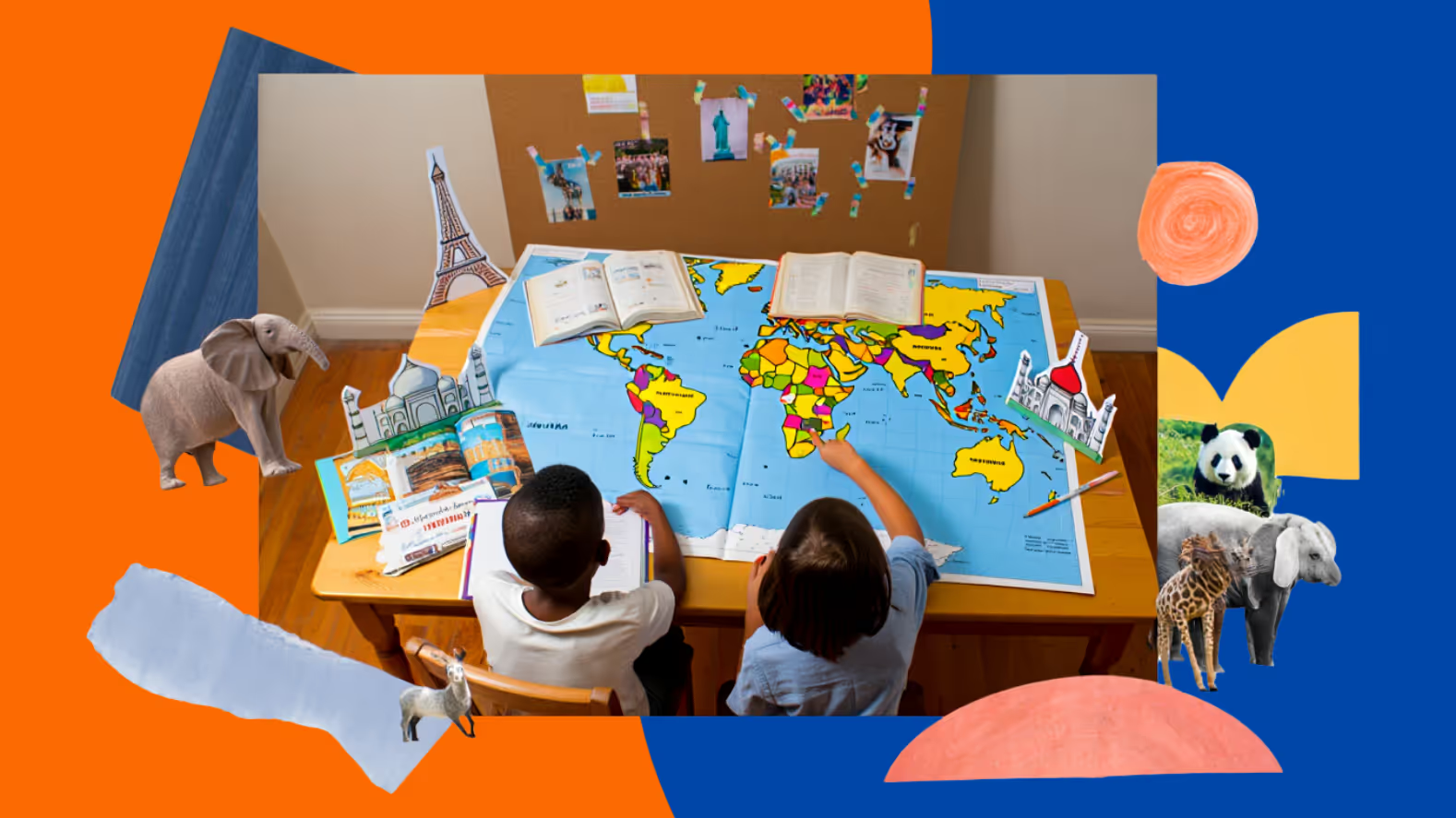
Third grade is a magical year. It’s when your kiddo takes that big leap from learning to read to reading to learn. There are also higher academic expectations this year, and how more complex material is presented can color a child’s view of school (and themselves as learners) for years to come.
Naturally, picking the right 3rd-grade homeschool curriculum can feel like a big decision. How do you cover all the essential subjects for their age while nurturing curiosity and keeping learning fun? It's a balance every parent hopes to strike, but without a background in education, it may take some trial and error to get things right.
We’ve put together this guide to help you decide on the best homeschool curriculum for your 3rd grader. Read on to learn subjects to cover, age-appropriate learning resources, and more.
Why 3rd grade is a turning point
Third grade is a pivotal year when the focus of education changes because kids are learning more on their own through reading. Research shows that the ability to read by the 3rd grade is critical to a child’s success in school, their future career, and even a nation’s economy.
In earlier grades, kids are primarily taught how to decode words and read. But in 3rd grade, reading is no longer just about sounding out words. Instead, students are taught to grasp the main idea, understand details, and make inferences — they learn to understand what they read.
Your kiddo will rely on their reading skills and other foundational skills built earlier to understand concepts across core subjects, like science, historical events, and math. Strong literacy skills help 3rd graders feel confident in their learning and focus on the subjects they’re being taught, so they’re less likely to fall behind.
Also, it’s around 3rd grade, and a little earlier, that children start to develop more advanced cognitive skills. Kids are starting to learn things like:
- Cause and effect
- Problem-solving
- Evaluating information
- Asking "Why?”
They’re moving beyond just remembering facts to thinking more deeply, analyzing, and questioning the world around them. So, a curriculum that supports a more inquisitive mind is a must.
Subjects to include in a 3rd-grade homeschool curriculum
From growing their vocabulary to exploring nature’s habitats, there are plenty of interesting topics to dive into this year. Here’s an overview of what subjects your kiddo should learn in 3rd grade as a homeschooler.
Language arts
In 3rd-grade language arts, your kiddo will take steps toward becoming a confident communicator and reader.
The primary goal for them is to build reading fluency and comprehension skills with more complex texts. This year, they’ll also focus on expanding vocabulary through reading exercises. For example, they'll learn how to use context clues to figure out new words.
In writing, 3rd graders practice expressing their ideas better through storytelling and informational writing. This includes using proper punctuation, capitalization, and accurate noun and verb forms.
Mathematics
Get ready for some fun math adventures in grade three. As lessons cover more advanced addition and subtraction, your child will solidify their understanding and boost their confidence with bigger numbers.
They’ll also get their first introduction to fractions and decimals, learning what fractions mean as parts of a whole, how to compare them, and how simple fractions relate to decimals.
Geometry is another core mathematics subject in the 3rd grade. Your kiddo will learn how to identify and classify different shapes. They might also learn things like how to measure the perimeter of a quadrilateral and apply it to real-world scenarios like building a fence for a garden or framing a picture.
Science
Third-grade science should spark your child's natural curiosity about the world around them through hands-on exploration.
Your kiddo will explore fascinating topics like the life cycles of plants and animals. They'll also investigate different habitats and food chains and explore the impact of climate change on our ecosystems.
There may be simple experiments and observations, like watching a plant sprout from a seed or observing insects in your backyard.
In earth science units, they’ll uncover the secrets of our planet. Things like basic weather patterns, water cycles, and different landforms will come to life in the right curriculum. These discoveries can help them develop a deeper connection to and appreciation of nature.
History and geography
In history, your kiddo will become a little time traveler. They'll get to learn about influential historical figures and delve into early civilizations.
This is where they learn that the past shapes the future. They'll also start playing with timelines, which helps them grasp how things change (or maybe stay the same) over time.
Then, in geography, they’ll learn about different kinds of maps and globes, and how to spot all the continents and oceans. Learning history and geography is a fantastic way to start building global awareness and appreciation for different cultures.
Electives
Beyond core academics, 3rd grade is a great time for your child to explore their passions and develop life skills through electives.
If your kiddo has an interest or talent in the arts, encourage them to express themselves creatively through drawing, painting, or design. You could introduce them to basic art concepts like colors, shapes, and textures. Or, if they’re into music, they might enjoy learning about different instruments, rhythms, and melodies.
Physical education is also important. Staying active helps your child develop important mobility skills. Whether it’s through playing catch, swimming, or dancing, they'll improve their gross motor skills and have fun.
You can also include other areas, like social-emotional learning, for a more holistic education. SEL teaches children how to manage their feelings, navigate conflict, make responsible decisions, and build meaningful relationships — all essential life skills for a happy and confident kiddo!
3rd-grade homeschool curriculum resources
There are tons of resources online that you can use to help your 3rd grader learn. These resources are great for homeschooling or just for adding to your child’s education.
Language arts resources for 3rd-grade homeschoolers
Help your 3rd grader shine with these reading and language arts resources:
- Sonlight Language Arts 3: Christian-based language arts resources, including workbooks for handwriting, spelling, and vocabulary.
- Logic of English: You’ll find everything from flashcards and handwriting practice to phonics games.
- Evan-Moor Daily Language Review: Daily practice to help your kiddo develop basic writing skills.
Mathematics resources for 3rd-grade homeschoolers
These math curriculum resources can help make numbers more engaging and understandable:
- Singapore Math: An excellent resource for grade-level math workbooks and manipulatives.
- Math-U-See: Help your kiddo connect math to the concepts behind the numbers. This math homeschool resource includes virtual manipulatives and video lessons.
- Prodigy Math Game: Your 3rd-grader will be asking to play this math game. It’s that fun.
Science resources for 3rd-grade homeschoolers
Spark your 3rd grader's curiosity about the world of science with these resources:
- REAL Science Odyssey: A secular homeschool science curriculum with grade-level science topics and hands-on experiments.
- Generation Genius: Engaging videos covering topics ranging from weather and erosion to the differences between balanced and unbalanced forces.
- Nancy Larson Science: Hands-on science lesson kits that are perfect for curious minds.
Social studies resources for 3rd-grade homeschoolers
Help your child discover the wonders of the past with these history curriculum choices:
- BookShark History: Your kiddo can see history come to life with literature-based history curriculum sets for 3rd grade.
- Beautiful Feet Books: Explore the past with global history sets for grades K through 4.
- The History Timeline Notebook: This notebook encourages kids to track what they learn through a master timeline. It’s great for reinforcing history lessons and helping your child see how the world has changed over time.
Art, music, and SEL resources for 3rd-grade homeschoolers
Nurture your child’s interest in the arts with these resources:
Arts and music:
- The Getty Museum at Home: Project amazing art onto your walls with this augmented reality app.
- Art For Kids Hub: You’ll never run out of art projects with these engaging instructional videos, covering drawing, painting, and origami.
- SQUILT Music Appreciation: This is a great option for parents who aren’t musically inclined but want to teach their kiddo about different instruments and composers.
Social-emotional learning:
Books that explore emotions, empathy, friendship, and problem-solving are a great place to start to spark discussions around feelings and ethical dilemmas.
For example, The Invisible Boy by Trudy Ludwig gently addresses inclusion, and Ruby Finds a Worry by Tom Percival helps children understand anxiety. Enemy Pie by Derek Munson is another great one for exploring friendship and conflict resolution.
bina's SEL worksheets also offer activities designed to help children understand and manage emotions and build positive relationships.
What does a day look like for a 3rd-grader learning at home?
There’s no single, perfect answer to what your kiddo’s day should look like, but it’s always good to include a mix of structured lesson time, independent work, and unstructured time for play.
Since 3rd graders are still developing their attention spans, short, focused learning blocks are generally more effective. An engaged 30 minutes of focused work is more beneficial than an hour of distracted, passive learning.
It’s important to pay attention to your child’s cues. For instance, if they become tired or frustrated with a subject, it may be time for a change or a short break.
Some children are morning learners, while others are more focused after lunch. The perks of homeschooling are being able to adapt to your kid’s natural rhythms for more effective learning.
Tips for building the right 3rd-grade curriculum for your child
Building your 3rd-grade homeschool curriculum can get overwhelming, especially when there are so many options. Here are some tips to help get you started:
Understand your kiddo’s learning needs
How does your kiddo learn best? Take the time to observe.
Do they love hands-on activities? Prefer seeing things visually? Or do they learn best by listening and discussing? Once you have a better idea of their learning style, you can tailor activities to match their inclinations.
Every kid also learns different subjects at different paces. So you’ll need to adapt to their learning pace for each subject. Your kiddo may need more time and practice to understand math concepts, while they might be light years ahead in science.
Look for ways to weave their favorite things into your curriculum. If they think monkeys are the coolest animal on the planet, make this animal the star in math lessons and arts and crafts projects. Does your child love a good story? Tie history to books with biographies and historical fiction. Learning becomes much more fun and engaging when it connects to your kiddo’s interests.
Embrace changes to the curriculum
A good curriculum shouldn’t be rigid. Don't feel tied to every page or lesson if it's not working — it’s okay to pivot.
Be ready to skip sections, supplement with other resources, or even switch to another program if one’s not working.
And since learning styles can evolve, what worked last month might not work today. Having regular check-ins with your kiddo can help you gauge their needs.
Leave space for creativity and questions
Flexibility is important in 3rd grade. Don’t pack every day to the brim. Leave open blocks of time for spontaneous discoveries, deeper dives into topics that interest them, and just time for them to be a kid.
Incorporate games, hands-on experiments, art projects and outdoor adventures to keep learning exciting and help them discover new passions.
When appropriate, let your child choose topics for research, books to read, or creative projects. This not only builds ownership but also intrinsic motivation.
What if you’re not sure about building a 3rd-grade homeschool curriculum?
It’s a big responsibility. Do you have time to research all the options and teach your kid everything they need to learn in 3rd grade?
As much as you want to say yes, it’s important to be practical. Ultimately, the goal is to give your kiddo the best education you can. And sometimes, that means you don't carry that burden alone.
Online schools are a wonderful alternative that offers a structured, yet more personalized learning experience. You can enjoy the benefits of homeschooling without the pressure of building and teaching the entire curriculum yourself.
With an accredited online school like bina, your child receives a quality education that aligns with international standards. We have the numbers to prove it: kids at bina score higher academically, surpassing US and UK averages with top 8% performance.
Start your 3rd-grade journey with bina
bina offers an immersive education, right in your home. Kids learn in a global online classroom and connect with students from all around the world.
Our 3rd-grade curriculum explores STEM subjects through real-world biomes. And, at the end of each biome, students develop a PBL project based on a UN sustainability goal to showcase what they have learned. This encourages critical thinking and problem-solving in a real-world context.
Social-emotional learning is also a core focus at bina — it’s woven into our entire learning process. Our holistic approach helps children develop self-awareness, social confidence, empathy, and communication and collaboration skills.
Plus, with small classes (up to eight students), every child gets the attention and support they need to truly thrive.
Accredited, full-time school for grades K-12
Bring the best of the classroom to your home
See if we're a fit

More to read
Everything you need to know about 6th-grade homeschool curriculum
Discover what makes a great 6th-grade homeschool curriculum and how to create a structure that supports academic growth, independence, and joy.

Everything you need to know about 2nd-grade homeschool curriculum
Explore what a great 2nd-grade homeschool curriculum looks like. Get subject breakdowns, top resources, daily schedules, and expert tips.
Everything you need to know about 4th-grade homeschool curriculum
Discover how to build a 4th-grade homeschool curriculum that sparks curiosity. Learn what to teach, how to adapt, and where support makes a difference.