Homeschool geometry curriculum: Choices, resources, and challenges
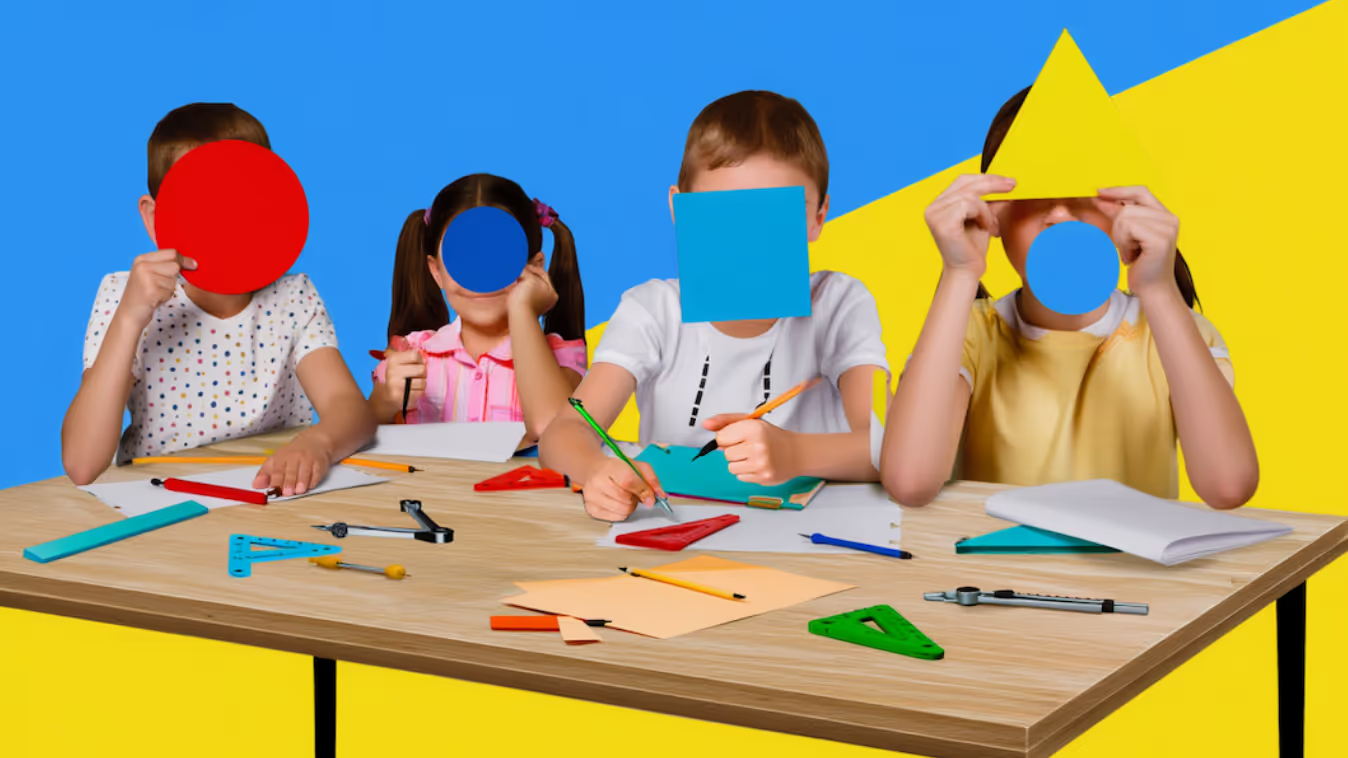
Many homeschooling parents feel confident teaching arithmetic or early algebra, but geometry can feel more challenging. Shapes, angles, and spatial relationships are harder to explain to young children who are still learning to visualize the basics of how objects fit together.
But it’s important to introduce geometry early. Understanding this subject helps build spatial reasoning, which supports everything from drawing to building. This serves as a great inroad for future interests like engineering and architecture.
However, if the lessons are too theory-based, kids end up disengaging. That’s why the best programs blend together clear explanations, visual tools, and hands-on activities. Let’s take a closer look at homeschool geometry curriculum options, extra resources, common challenges, and how bina approaches teaching math topics like geometry.
Different types of homeschool geometry curricula
An effective homeschool geometry curriculum strikes a balance between theory and practice. It should be interactive enough to keep kids engaged, but structured enough to build essential skills step by step.
Let’s look at a few of the ways you can teach geometry at home.
Textbook-based geometry
Textbooks are often the first tool parents think of when building a geometry curriculum for their kiddo. And they’re useful as they provide a clear path, moving step by step from basic shapes to more advanced topics like triangle congruence or coordinate geometry.
Younger learners might start with coloring in symmetrical designs, tracing lines, or labeling corners on a square. As they grow, textbooks guide them into measuring angles, recognizing congruent figures, and later exploring the Pythagorean theorem.
While they offer clear learning progression and a strong curriculum scaffold, textbooks can be a little heavy on memorization over real-world application. Make sure to balance textbooks with extra resources that encourage hands-on learning and visualization.
Digital/interactive geometry
Online platforms are great for turning geometry into an interactive activity. And with video lessons, animations, and auto-graded practice, students get instant feedback on how well they’re doing. At the same time, parents can track progress within a parent portal.
These digital lessons often feel less like “schoolwork” and more like a game, with gamified elements that keep children interested.
This approach often includes activities like:
- Dragging shapes on a tablet to build a house
- Matching angles to open the next level of a quiz
- Coloring in tessellations
- Sorting everyday objects by shape
A major plus point is that digital programs often let children progress at their own pace. However, make sure you research the programs before signing up, since they vary in depth and quality.
Early reasoning and problem-solving geometry
A reasoning and problem-solving approach to geometry teaches children the why behind geometry, not just the what.
Rather than memorizing that “a square has four equal sides,” this approach helps kids discover the rule for themselves by measuring, comparing, and noticing patterns. This method shows children that math isn’t random — it’s logical and every concept can be explained step by step.
This approach is important because it helps kids think critically from a young age. Rather than simply copying answers, they learn how to justify their thinking. This sharpens their deductive reasoning and deepens their conceptual thinking.
In practice, reasoning-based geometry activities for elementary children might include:
- Cutting out different triangles, lining up the corners, and seeing how they always form a straight line, showing that a triangle’s angles always add to 180°
- Using mirrors to test reflections so they understand symmetry
- Placing Lego bricks side by side to see if they match exactly to demonstrate congruence
By treating geometry as a series of discoveries rather than rules to memorize, children start to see math as something they can reason through.
Manipulative and construction-based geometry
For many younger learners, geometry makes the most sense when they can hold it in their hands.
A construction-based approach includes activities like:
- Building 3D shapes out of clay, popsicle sticks, or paper nets to see how sides, edges, and corners connect
- Painting a picture made entirely of triangles to understand tessellation
- Drawing and cutting a cube’s net to understand how 2D shapes become 3D shapes
These activities do more than entertain. They strengthen spatial reasoning, boost memory, and make abstract concepts feel real. If you decide to use math manipulatives and construction-based geometry, be ready to purchase and prepare materials. This is a very playful, hands-on approach that involves a lot of resources.
Five homeschool geometry curriculum choices
There’s no single “right” homeschool geometry curriculum. Some families prefer gentle, exploratory programs, while others need the structure of a textbook or the flexibility of online classes.
Here are five popular options to teach geometry to your child as they progress through each grade.
1. Miquon Math – Geometry Modules
For grades one to three, Miquon Math introduces geometry through hands-on discovery. Children use Cuisenaire rods, drawing, and guided activities to explore shapes, symmetry, and area.
A lesson might involve creating symmetrical patterns, comparing perimeters with rods, or building basic 3D shapes. Rather than memorization or formal testing, assessments hinge on discussion, observation, and tangible project work.
Pros:
- Introduces geometry gently for young learners
- Encourages creativity and exploration
- Takes a tactile approach, which works well for kinesthetic learners
Cons:
- Needs parent setup and discussion time
- Requires supplementary resources as it’s not a full curriculum
2. Math Mammoth - Geometry
Aimed at grades one to five, Math Mammoth Geometry blends early geometry with measurement concepts.
Students work directly in a worktext by drawing lines, labeling shapes, or sketching floor plans. Available as a printable PDF or digital download, this course is designed to be clear and affordable.
Pros:
- Offers a low-cost option that’s reusable across siblings
- Includes strong visuals and explanations for independent learning
- Covers key geometry topics without overwhelming young learners
Cons:
- Focuses on worktexts rather than hands-on projects
- Requires printing if not used digitally
3. Teaching Textbooks Geometry
As your little one progresses into the higher grades, Teaching Textbooks offers a self-paced online course with narrated video lessons, interactive visuals, and automated grading. Students can pause, replay, or work through virtual constructions, while parents track progress in the built-in parent portal.
Pros:
- Saves parents' time thanks to automated grading
- Supports different learning styles through step-by-step video instruction
- Allows students to pause, review, and repeat lessons as needed
Cons:
- Requires an internet connection for most features
- Covers formal reasoning in less depth than textbooks
4. Saxon Geometry
Saxon Geometry offers the next step up for high schoolers. It’s a classic, textbook-based approach with a strong focus on logical reasoning and proofs.
Students work through Euclidean geometry, theorems, congruence, circles, and coordinate geometry in a consistent lesson-practice-review cycle.
Pros:
- Builds a solid foundation in reasoning and proofs
- Provides a structured, predictable format that supports steady progress
- Includes test booklets, solutions manual, and answer keys for easy grading
Cons:
- Focuses on text-heavy theory with limited visuals
- Feels repetitive for advanced learners
5. Art of Problem Solving (AoPS) Geometry
Created for students in grades nine to 12, AoPS Geometry challenges learners to dive deep into theorems, constructions, and problem-solving strategies.
Lessons encourage independent exploration before reading through the full explanations to foster a deeper understanding of the concepts. Activities might include designing original proofs, solving competition-level problems, or exploring geometric loci.
Pros:
- Prepares advanced students for STEM and math competitions
- Builds strong problem-solving and analytical skills
- Offers both textbooks and online classes
Cons:
- Requires a significant time commitment
- Assumes prior strength in Algebra 1 and Algebra 2
Additional resources for homeschool geometry
A strong homeschool geometry curriculum doesn’t rely solely on an official program. It combines extra resources to make abstract ideas feel more tangible, giving children chances to build, explore, and see math in action.
From manipulatives to museums, these tools enrich lessons at every age.
Math manipulatives and geometry toolkits
Manipulatives are physical objects like blocks, tiles, or geometric solids that children can move around to test ideas. They’re useful because they let kids see and feel concepts like symmetry, area, or congruence instead of just reading about them.
This hands-on approach builds spatial reasoning skills and helps visual learners make connections between formulas and real life.
Look for geometry toolkits like:
- Pattern blocks for exploring tessellations
- Tangrams for geometric problem-solving
- Geoboards for creating shapes with rubber bands
- Simple kits with compasses, protractors, and rulers for drawing shapes and measuring angles
Dynamic geometry and CAD software
Geometry and design software programs allow students to build and transform figures on screen. They’re useful because children get instant feedback. They can drag, flip, or rotate a shape and immediately see what happens. This encourages exploration and “see–do–prove” thinking.
Tools range from simple 2D apps, like GeoGebra or Desmos Geometry, to 3D design platforms, like Tinkercad, where kids can create digital models of buildings or bridges.
Be aware that some of these tools are quite expensive.
Architecture, engineering, and math museums and tours
Museums and city tours bring geometry into the real world. Walking through exhibits of bridges, domes, or mosaics shows children how we use math in the real world to design and engineer the structures and machines we need.
These experiences spark curiosity and inspire projects back at home. For example, the Science Museum in London highlights the role of geometry in architecture, while MoMath in New York City lets children interact with hands-on math installations.
Makerspaces and build kits
Makerspaces are community workshops that children can attend, while home kits offer a similar task-based approach at home. Both let children experiment with building and engineering projects.
They’re valuable because they connect geometric ideas like symmetry, congruence, and load-bearing angles to real construction challenges.
Good examples include LEGO Education sets, K’NEX bridges, or cardboard engineering kits where children design their own structures.
Art, tessellations, and origami resources
Art projects link geometry with creativity. They help children understand transformations, symmetry, and patterns while also developing fine motor skills.
Parents can use coloring pages with tessellations, origami projects that fold paper into 3D shapes, or books on Islamic geometric design. These activities remind children that math isn’t only practical. It’s also beautiful.
Challenges of homeschool geometry lessons
While it’s certainly possible to teach geometry at home, there are a few hurdles parents commonly experience. Knowing these challenges and how to address them can make lessons smoother for both parent and child.
Access to specialized tools and materials
Geometry often requires instruments like compasses, protractors, rulers, or 3D solids. Without them, activities like construction-building or spatial reasoning can feel incomplete.
To prevent costs from stacking up, you can:
- Invest in a simple geometry toolkit
- Use free apps like GeoGebra, or substitute with printable nets and everyday objects
- Head to local libraries or makerspaces that provide access to models and design tools
Balancing theory and visual learning
It’s easy to rely on worksheets and formulas, but most young children will grasp the concepts better if they can see and build them.
To balance theory with real-world understanding, mix in everyday examples, like designing a garden layout or tiling a floor plan. Throw in trips to museums or architecture exhibits so kiddos can see how geometry plays out in real life.
Assessment without formal exams
Without tests, parents often feel like they struggle to see their child’s progression.
But geometry isn’t just about getting the right answers. It’s also about the process of reasoning along the way. That’s why journals, diagrams, or mini-presentations offer a great way to track progressions as children need to explain their thinking. That way, you can clearly see whether they truly understand or if they’re just recalling answers from memory.
Parent confidence in teaching geometry
Lots of people feel like math is their weak point, leaving homeschooling parents feeling intimidated about teaching it. There’s no need to worry. There are lots of free resources to help parents learn alongside their children, including Khan Academy videos, homeschool co-ops, and guided online courses.
How bina teaches your child geometry
At bina, geometry is part of a full, interconnected school curriculum, taught through our biome-based, project learning approach.
Every term, students explore a different biome — like the Amazon rainforest or the Sahara desert — and use real-world challenges to uncover mathematical concepts.
For example, in a Rainforest unit, they might design a sustainable tree canopy walkway, calculating angles, lengths, and load-bearing capacities while also studying local ecosystems, cultures, and history.
Geometry skills, like all math skills at bina, aren’t taught in isolation but applied alongside science, geography, and art to make learning both practical and memorable. Each year, students revisit biomes at increasing levels of complexity, so their skills and understanding deepen over time.
To make sure all students feel challenged and supported, bina uses personalized pacing with tailored goals and real-time progress tracking. And because bina offers small global classrooms with two educators, children benefit from expert guidance and rich peer discussion, while gaining diverse perspectives on how geometry shapes the world — from indigenous architecture to modern engineering.
bina offers families a dynamic alternative to traditional homeschooling, combining global, small-class learning with hands-on, real-world projects that make every subject relevant and engaging. If you’re looking for an at-home education for your kiddo, book a call with us to see if we’re a good fit.
Accredited, full-time school for grades K-12
Bring the best of the classroom to your home
See if we're a fit

More to read

Homeschool music curriculum: Choices, resources, and challenges
Discover the best homeschool music curriculum options, extra resources to aid learning, common challenges, and how bina can help.


Homeschool history curriculum: Choices, resources, and challenges
Explore your options for homeschool history curriculum. Learn about different programs, find helpful resources, and explore precision learning with bina.

Nature-based homeschool curriculum: Choices, resources, and challenges
Discover the types of nature-based learning, which nature based homeschool curriculum options exist, and how bina helps kids understand the world.