Biology homeschool curriculum: Choices, resources, and challenges
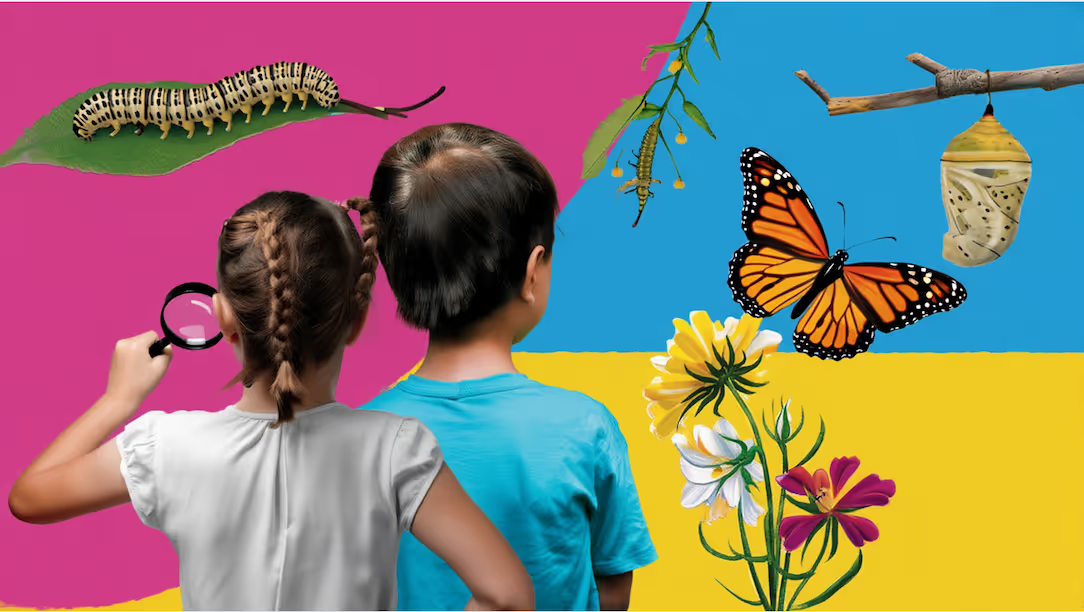
Many parents choose homeschooling to personalize their child’s education and nurture curiosity. But when it comes to science topics like biology, you might worry about matching the hands-on lab work schools provide. Without microscopes, specimens, or guided experiments, lessons can feel textbook-heavy.
However, with the right homeschool biology curriculum, you can bridge this gap with interactive tools, resources, and approaches that make the subject both accessible and engaging.
Let’s take a closer look at the different types of homeschool biology curricula, resources for parents, and how bina can help.
Different types of homeschool biology curricula
When kiddos are little, biology shouldn’t just be about memorizing long definitions. It’s about noticing, touching, and asking “why?” A good homeschool biology curriculum for young learners makes space for curiosity, while setting the stage for learning core concepts.
Here are some common approaches families use, along with ideas for what to do as children get older to help them dive deeper.
Textbook-based biology
Textbooks and workbooks give structure to any homeschool curriculum. At the early stages of learning, this might look like a colorful science reader or a workbook with short passages on biology topics, like how living things produce energy and water cycles.
Students might read a section on cell biology, label a diagram of a seed, or complete a simple quiz on bio vocabulary words to help build foundational knowledge.
This approach gives parents peace of mind that they’re covering all the basics around plants, animals, and ecosystems. Research published in Disciplinary and Interdisciplinary Science Education Research shows that using textbooks helps kids stay engaged while offering a clear framework that makes it easy for students to review and revisit skills and knowledge.
Just be careful that this doesn’t turn into a memorization exercise. Tie learning to real-world examples so kids can actually see how biology works.
Lab-based biology
This is where things get exciting, because experiments make science feel real.
But you don’t need a fancy lab. Experiments can look like this:
- Putting potato strips in salt water to demonstrate osmosis
- Using a compound microscope to observe onion cells
- Watching a jar of fermenting cabbage bubble as yeast and bacteria produce gas and acids
For older kids, you can go further with soil salinity tests or even safe DIY kits that glow with bioluminescence.
These experiments build confidence with tools and give kids a real taste of the scientific method.
Remember, though, that while exciting, equipment costs can grow if you’re not careful. Also, things can get a little messy, so be prepared for the cleanup.
Project-based biology
Project-based methods also take on a hands-on approach. But unlike lab-based methods, projects stretch learning over days or weeks.
Think…
- Salt-dough models of animal cells with labels and short explanations of how things work
- A mini-garden experiment testing sunlight vs. shade
- A homemade worm bin to watch composting in action
These activities get kids to ask questions, research ideas, solve problems, and think like young scientists, improving critical thinking and problem-solving skills.
While they may take more preparation and follow-through from parents, the payoff is big. Longer projects give kids time to observe changes, track results, and connect patterns so they truly understand how biology shapes the world.
Digital/virtual biology
Online programs like CK-12 Biology or interactive apps let students dive into animated cells, run virtual dissections, or test their knowledge with quizzes.
Younger learners might enjoy games about habitats, while older kids might work through a self-paced online Apologia Biology course.
The upside is accessibility — less mess, instant feedback, and progress tracking. The downside is the screen-time juggle and making sure the content in the course you pick is solid.
Nature-based biology
Sometimes the best lab is right outside. A study published in the journal Educational Research shows that outdoor learning helps kids focus longer and sparks better questions.
With a nature-based biology approach, you might:
- Watch pollinators in the garden
- Measure how fast bean sprouts grow
- Track the patterns of the tides
- Sketch plants or insects in a nature journal
- Collect and classify different types of seeds
- Observe how shadows change with the sun’s position
Of course, weather and access to safe green spaces can get in the way. But even a balcony garden or a park walk can bring life science to life.
Five homeschool biology curriculum choices
If you’re looking for a ready-made homeschool biology curriculum, there are plenty of options out there. Each one has its own style — from hands-on projects for younger kiddos to structured courses that count toward a college-prep homeschool biology curriculum.
Here are five popular picks, what they offer, and what to keep in mind.
1. REAL Science Odyssey: Life
This secular homeschool program is for early learners in grades one through four.
It introduces core life science topics like plants, animals, human anatomy, habitats, and basic cell biology. Lessons are short and include over 20 simple lab experiments using everyday items like beans, flowers, and magnifying glasses. Instead of tests, students keep a journal or notebook to reflect on what they’ve learned.
Pros:
- Strong emphasis on hands-on science using affordable materials
- Secular and beginner-friendly
- Activities are short, fun, and age-appropriate
- Clear parent guide supports non-science-trained adults
Cons:
- Requires consistent parent involvement for labs
- Not a complete multi-subject curriculum
2. Elemental Science: Biology for the Grammar Stage
This program follows a classical education approach, which is broken into three stages: grammar, logic, and rhetoric. The grammar stage (1st through 4th grade) is all about soaking up facts and vocabulary.
In biology, this means learning the names of animals, plant parts, and body systems while practicing narration, copywork, and journaling.
Each week blends readings from illustrated encyclopedias with simple experiments and nature study. Parents get a teacher’s guide with supply lists, scripts, and notebooking pages so kids build a portfolio of their work.
Pros:
- Mixes literature, science, and nature study for a rich learning experience
- Weekly structure keeps families on track
- Notebooking pages help with assessment and record-keeping
- Affordable and reusable for siblings
Cons:
- Requires the purchase of specific reference books
- Heavy on parent-led teaching
3. CK-12 Biology
This free, standards-aligned high school biology ebook covers everything from biochemistry to ecosystems. For ages 11 through 18, it includes simulations, quizzes, and optional labs.
Families can use it as a full high school biology curriculum or just as a supplement. Parents can track progress, assign lessons, and even adjust the level to match their child’s needs.
Pros:
- Completely free and flexible
- Multimedia-rich with videos and simulations
- Built-in quizzes and progress tracking
- Suitable for independent learners
Cons:
- Needs reliable internet access
- Lab activities require extra setup at home
3. Oak Meadow: Biology
An accredited homeschool program for high schoolers, Oak Meadow offers a literature-rich high school biology curriculum.
It covers genetics, ecology, evolution, and more through reading, labs, and cross-disciplinary assignments. Students might write essays on bioethics, build ecosystem models, or conduct field studies.
The program includes a clear schedule, grading rubrics, and teacher support, if families want it.
Pros:
- Accredited and aligned with mainstream science standards
- Strong emphasis on creativity and critical thinking
- Variety of scientific approaches
- Flexible pacing with teacher support available
Cons:
- Requires lab supplies and field materials
- Higher cost than open-source resources
4. Cambridge IGCSE Biology
Globally recognized and exam-focused, this homeschool high school biology curriculum prepares ages 14 through 16 for the International General Certificate of Secondary Education (IGCSE) qualification.
Students study principles of biology like cells, genetics, ecology, and biotechnology.
Most families access it through distance-learning providers who supply a high school biology textbook, assignments, and past exam papers. You can often adapt lab experiments for home or replace them with virtual simulations.
Pros:
- Recognized by universities and employers worldwide
- Clear, structured syllabus and progression
- Good fit for students seeking formal qualifications
- Ideal for independent learners
Cons:
- Very exam-oriented
- Some labs need adaptation for home use
Additional resources for homeschool biology
A great homeschool biology curriculum doesn’t rely only on textbooks or lab manuals. Instead, families tap into a wide range of resources that make science richer, more interactive, and more connected to the real world.
Here are some extra resources to support your at-home biology lessons.
Local science centers and museums
Science centers give kids a chance to step into biology with all their senses.
From touch tanks and butterfly houses to live animal enclosures, these spaces bring concepts like ecosystems, evolution, and cell biology to life. Many museums host homeschool days or workshops designed for different age groups.
For example, a trip to the Natural History Museum in London, the California Academy of Sciences, or even smaller regional centers can spark questions and inspire projects at home.
Citizen science projects
Students can also contribute to real research through citizen science projects.
Whether it’s counting garden birds, surveying local plants, or submitting photos of pollinators, these types of projects help kids practice scientific methods in a meaningful way.
Popular choices include the RSPB’s Big Garden Birdwatch in the UK, BioBlitz events across the US and Europe, or global programs like CoralWatch on the Great Barrier Reef.
Microscope kits and lab equipment
Microscope kits with prepared slides let children see onion cells, leaf structures, or even microorganisms up close. You can also create your own slides to take a deeper look at what’s happening in your own world.
Families can expand with extras like a dissection kit or simple tools for culturing yeast or bacteria.
These hands-on tools reinforce lessons in cell biology, microbiology, and anatomy.
Field guides and biology reference books
Books are still one of the most versatile tools.
A good field guide, like the Peterson series in the US or Collins Complete Guide to British Wildlife, turns a nature walk into a biology lesson.
These reference books help kiddos identify plants, fungi, or insects and build classification skills, connecting outdoor observations to formal study.
Online biology databases
Digital platforms such as iNaturalist, the Encyclopedia of Life, or the NCBI give students access to global biodiversity data. Kids can browse species records, genomes, and research papers while building digital literacy and research skills.
Challenges of homeschool biology lessons
Biology is full of wonder, but teaching it at home can bring unique hurdles. Without access to a school lab, it sometimes feels tricky to keep lessons exciting and balanced.
Here are some of the challenges to bear in mind, with a few tips to help you overcome them.
Keeping biology engaging at home
It can feel tough to come up with a steady flow of safe, age-appropriate experiments. And without resources that help you provide variety, activities can fall into a constant loop of bean sprouting or baking soda volcanoes.
Here are a few things you can try to keep experiments exciting:
- Rotate through household science activities using online resources for inspiration
- Use nature walks or gardening as mini-labs
- Follow real-world science news and link it to lessons
- Turn cooking projects into biology explorations
- Create scavenger hunts, or mini-collections
- Partner with homeschool co-ops for shared experiments
- Explore reusable science kits and dive deeper into the experiments as children gain more knowledge
Balancing theory and hands-on work
It’s tempting to lean on worksheets or videos when resources feel limited. But biology clicks best when children can test ideas in the real world — whether that’s examining leaves, observing ants, or simulating osmosis in the kitchen.
Pair reading with experiments, scheduled trips to aquariums or science centers, and outdoor field science to make lessons feel more meaningful.
Assessment without formal exams
In science, understanding isn’t just about the right answer. It’s about reasoning. However, parents often struggle to understand their child’s progress without formal tests showing whether they’re getting the answers right.
To combat this, build portfolios of diagrams, lab notes, or photos of experiments that document growth, and use oral presentations to build confidence.
How bina teaches your child biology
If you’re looking for a different approach, bina offers a full online elementary curriculum.
Within our curriculum, science and biology aren’t taught as lists of facts. We bring these subjects to life through real-world connections. Our curriculum is built around biomes like rainforests, oceans, and tundras, so every lesson links directly to how ecosystems function and why they matter.
Students revisit these biomes as they grow, exploring them in greater depth each year. Early learners might identify plants and animals, while older students investigate ecological relationships, conservation, and global sustainability. With a layered approach, kiddos build a lasting understanding that makes sense in the real world.
Also, we don’t separate biology from other subjects. Instead, we integrate it through project-based learning. Instead of memorizing for tests, students apply their knowledge to real challenges, developing both scientific skills and critical thinking.
And with small classes of up to eight students and two dedicated educators, every child receives personalized attention. We adapt lessons and track progress with ongoing feedback and skill milestones.
Best of all, our classrooms bring together learners from around the world, so students gain diverse perspectives on science and its role in solving global challenges.
Interested in finding out more about what being a learner at bina is like? Book a call to see if we’re a good fit.
Accredited, full-time school for grades K-12
Bring the best of the classroom to your home
See if we're a fit
More to read
Homeschool music curriculum: Choices, resources, and challenges
Discover the best homeschool music curriculum options, extra resources to aid learning, common challenges, and how bina can help.

Nature-based homeschool curriculum: Choices, resources, and challenges
Discover the types of nature-based learning, which nature based homeschool curriculum options exist, and how bina helps kids understand the world.

Homeschool history curriculum: Choices, resources, and challenges
Explore your options for homeschool history curriculum. Learn about different programs, find helpful resources, and explore precision learning with bina.