Secular homeschool curriculum resources for elementary-aged kids
If you’ve decided to have your child learn at home, you’ve probably been exploring different curriculum options. Some are faith-based, and others aren’t. If you’re not particularly focused on finding a homeschool curriculum that reflects your family’s religious beliefs, secular may be the way to go. A secular homeschool curriculum is for families that prefer a learning pathway that’s free from religious content.
Because secular learning resources and online programs aren’t focused on a specific faith, there are lots of options available. In this guide, we discuss the benefits of a secular curriculum (even if you have your own faith) and share plenty of resources, including our full-day online school that’s open to kiddos from all walks of life.
What is a secular homeschool curriculum?
A secular homeschool curriculum keeps religion and faith out of the learning environment. It focuses on academics rather than belief systems, so you won’t find religious topics tied to science experiments, history, or written activities.
If we look at traditional school settings in the US, there are laws that prevent public schools from promoting one set of beliefs over another. In other words, public schools are legally required to be secular. On the other hand, around 84% of private schools in America are religious. Public education is secular in most European countries and Australia, while there’s a mix of secular and faith-based publicly funded schools in the UK.
For parents who want their children to learn at home, it’s a personal choice. Even if you’ve decided on a secular curriculum, it doesn’t mean you can’t share your faith with your child in other ways.
For homeschool families, a secular homeschool curriculum might revolve around curiosity or follow a classical learning model, which focuses on critical thinking and communication skills. But finding the right resources isn’t always easy. Do you build your own curriculum, buy a complete package, or opt for online school? Should you choose a specific type of secular pathway, such as nature-based or project-based learning?
For families, these decisions can be overwhelming. Even if you already know you want a secular program, figuring out the finer details can take time. If you love the idea of a secular, inclusive, deeply engaging education but want support and time to work while your child learns, bina may be the right fit. Our virtual school offers your child a well-rounded education with expert teachers, small class sizes, and biome-themed lessons that tie learning to the real world.
Why choose a secular homeschool curriculum?
There are different reasons why you might choose this style of learning. For example, a secular homeschool curriculum has more room for exploring classical science, innovative thinking, and social-emotional growth. It also gives families the freedom to explore faith in their own way.
Here are some of the benefits you can expect from a secular education:
Promotes inclusivity
A secular homeschool curriculum is neutral, so it’s inclusive of all students regardless of their faith or background. Kiddos can explore, debate, and discuss ideas freely.
This style of learning supports a broader worldview. While focusing on academics and diving into different views within topics like history and government, students learn to put themselves in other people’s shoes.
It’s worth noting that even in secular settings, some subjects can be taught through a Western lens. Christianity may still receive more attention than other belief systems like Buddhism or Judaism.
Develops critical thinking skills
With a secular curriculum, kiddos learn to think for themselves and form their own opinions. Instead of looking at things from the perspective of just one faith, they have to dig deeper. This means asking questions, finding solutions, and evaluating the answers.
When there’s no such thing as a silly question, kiddos can feel confident taking part in thoughtful discussions and debates.
Gives you flexibility
With a secular curriculum, you’ll have the space to share your family values when the time is right. So, if you are religious, you can teach your child about your faith outside of school hours in a way that’s personal and meaningful.
A secular homeschool education lets you shape your child’s education and focus on the fundamentals. And, with so many different resources, you can build something that suits your family.
10 resources for secular homeschooling
Homeschooling is a big decision, and knowing where to start isn’t always easy. We are here to help with a huge list of secular resources that’ll enhance your child’s learning.
Let’s take a look.
Secular homeschooling resources for STEM
STEM stands for science, technology, engineering, and math. Here are some of the top secular resources for these subjects:
1. Math Mammoth
Math Mammoth is a comprehensive curriculum for grades one to eight. It comes from author Maria Miller, an experienced math teacher and homeschooler.
The program starts with basic math concepts and visual exercises and gets more abstract as students progress. There are different options to choose from, including a full curriculum, bundles, and digital downloads.
Basic packages start from around $30 and scale up to $300 or more.
Learn more about Math Mammoth.
2. Mathletics
Mathletics is a popular online program with fun math games and challenges. With activities for children from five to 16 years, it is a child-friendly solution that can be used during and after-school sessions.
Mathletics engages students and reinforces their daily lessons. It also gives kiddos who are ready for the next level more challenging problems.
There’s a free trial, and you can purchase an annual subscription for around $100 per year.
Learn more about Mathletics.
3. Elemental Science
Elemental Science has options for all ages, from preschool to high school. You’ll find a series of science programs with both theoretical and practical components. So, once children learn the basics, they can test their skills and knowledge with fun, hands-on experiments.
It covers a range of subjects including biology, earth science, astronomy, and physics. Plus, you can find bundles with a little bit of everything.
You can buy individual resources for a few dollars, or purchase a bundle for $70 or more.
Learn more about Elemental Science.
4. Twig World
Twig World is a curriculum with a range of STEM subjects, including math, physics, chemistry, and biology. It comes with flexible learning resources, experiments, and high-quality videos.
It’s made for kiddos between 11 and 16, and they can learn at their own pace with extension tasks available. Twig World has free demos, and if you decide it’s the right fit, you can subscribe for 12 months.
Learn more about Twig World.
5. Adventure Academy
Adventure Academy is a virtual world where children can play and learn at the same time. This interactive program has thousands of activities, and kiddos can log in from anywhere. To boost engagement, they can play with others and create their own unique characters.
It’s for children aged eight to 13, and they can learn everything from basic multiplication to how molecules and atoms work.
You can get a free trial, and then pay around $13 per month.
Learn more about Adventure Academy.
6. Tynker
Tynker helps your child gain those important technology skills that they need for the future. This is a coding program that starts with the basics and gets more complex as students progress.
Games, puzzles, and blocks keep kiddos engaged, and it’s easy to access with mobile apps. They can even choose pathways that interest them, such as Minecraft, JavaScript, or Python.
There are 300 learning modules for kids five and over, all the way up to 18. You can pay for a monthly, yearly, or lifetime subscription.
Learn more about Tynker.
Here are even more secular resources for STEM:
- Science Unlocked has full-year science curriculum packages for at-home learners.
- Prodigy Math uses games to make learning math fun.
- Khan Academy offers videos, lessons, and quizzes in all grade levels for math.
- Kodable Education teaches kids basic programming skills.
Other secular homeschooling resources
STEM subjects won’t be the only resources on your radar. Here is a selection of other leading secular homeschool resources, from reading to art:
7. Reading Eggs
Reading Eggs supports your child as they learn to read. It’s an interactive program, and you can choose your preferred style of English — whether it’s American, British, or Australian spelling.
This program focuses on all the key areas, such as phonics, comprehension, and vocabulary. There are games, songs, rewards, and interactive activities to encourage kiddos to keep logging in.
It’s made for two to 13-year-olds and there are assessment tasks that tie in with home learning. The subscription price varies depending on your child’s age and stage, and there is a free trial available.
Learn more about Reading Eggs.
8. All About Learning Press
All About Learning has dedicated programs for spelling, reading, and math, so you can use it to fill any gaps in your child’s learning.
It is recommended to spend around 20 minutes per day on this curriculum. The content is aimed at “mastery grades” instead of year level, so your child can learn in a way that suits them.
You can expect to spend over $100 on a starter set, but this varies between the content.
Learn more about All About Learning Press.
9. Beyond the Page
Beyond the Page is there to help your child reach all of their academic milestones. It’s ideal for students who are gifted or those who prefer a more creative style of learning.
It is a well-rounded curriculum that features core subjects such as science, social studies, languages, and math. Each 36-week curriculum is based on age, from junior primary through high school.
A full-year package can cost you hundreds or thousands of dollars, depending on your child’s age.
Learn more about Beyond the Page.
10. Blossom and Root
Blossom and Root offers a nature-based secular pathway. It comes from former teacher and art director Kristina Garner, who homeschooled her own children.
It’s a very hands-on curriculum with plenty of art, literature, and outside play. It spans from the early years until grade six, and each component is designed to require minimal preparation.
Volumes start at $20 and scale up to $100 or more.
Learn more about Blossom and Root.
Here are even more secular resources:
- WriteShop offers workbooks that help kids improve their writing and grammar skills.
- Grammar Galaxy makes learning grammar fun with space mission-themed lessons.
- Curiosity Chronicles provides secular global history resources for kids learning at home.
- Build Your Library is a great resource if you’re looking for a literature-based secular homeschool curriculum.
- Waldorfish offers art-based Waldorf-inspired secular homeschool materials and learning resources.
Secular at-home learning with expert teachers at bina
A traditional school setting isn’t for everyone, and there are a wide range of reasons why parents decide to keep their kiddos at home using a secular curriculum. However, even if you have decided on an alternate to public school, it doesn’t mean you have to do it alone. With bina, your child will get all the support they need in a cozy and welcoming learning environment.
Expert Bruce D. Perry, MD, PhD explains the need for children to feel comfortable in order to learn. He says, “When they feel safe, they will leave their comfort zone, and explore new ideas that you're introducing. And this is really, again, the hallmark of an optimal developmental environment, an optimal healing environment, an optimal educational environment, an optimal parenting environment, is safety.”
bina has live learning with expert teachers and small class sizes. The secular curriculum is inclusive and globally minded, with projects tied to UN sustainability goals. Our students are from all over the world, and we personalize the learning environment to our students so we can help spark joy in every kiddo. Also, our parent support team is the best, so you always have an expert Learning Success team on hand to talk to about your child’s education.
Our online school is a stress-free pathway for parents that gives your child the benefits of a secular curriculum built for the real world. bina is accredited, and children can study from anywhere in the world.
Accredited, full-time school for grades K-12
Bring the best of the classroom to your home
See if we're a fit
More to read
1st-Grade Homeschool Curriculum Resources and Tips
Explore top 1st-grade homeschool curriculum picks, tips for planning your day, and why bina’s accredited program may be your perfect fit.


Summer homeschool curriculum ideas without school-at-home
Summer often gives parents a clearer picture of how their child actually likes to learn. Some children suddenly read for fun again. Others become more…

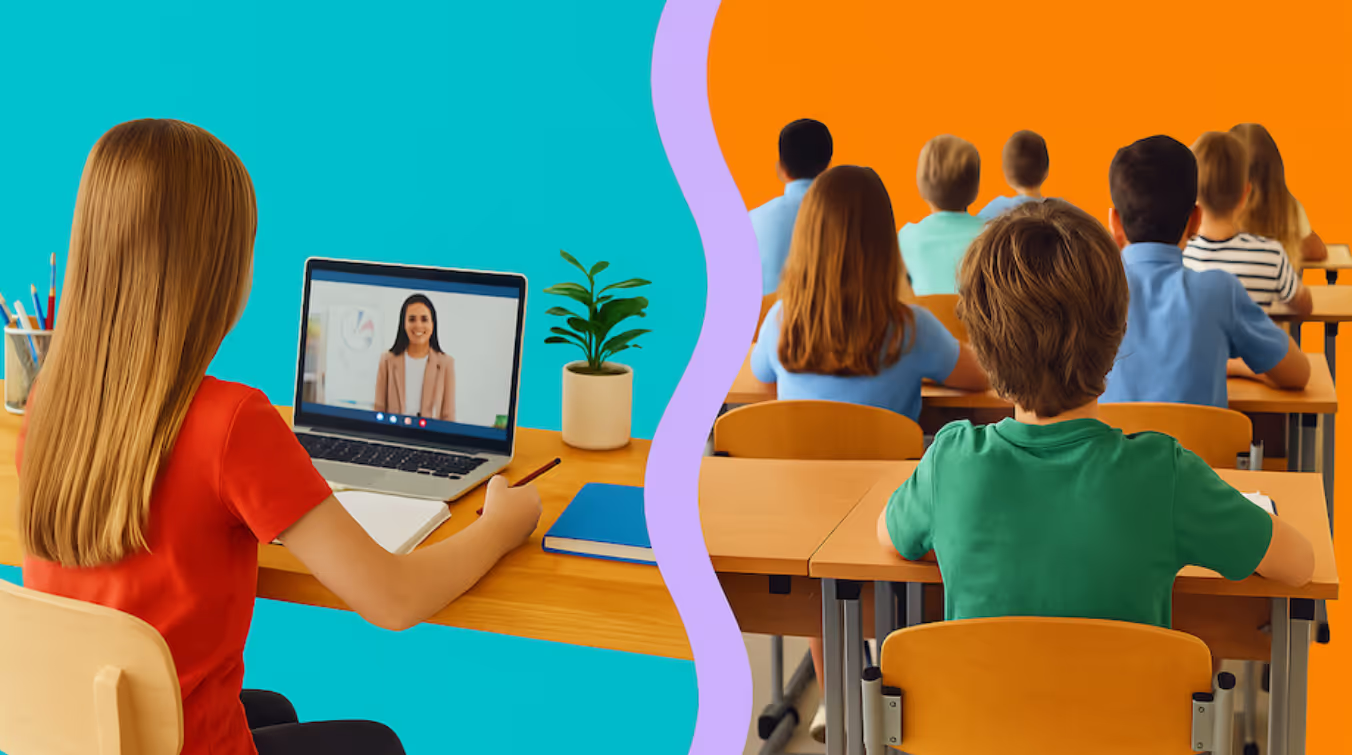
Online school vs. public school: Which is best for your child?
Learn how online school compares to public school regarding curriculum, flexibility, cost, and support. See why online learning may be the better fit.