How to plan a homeschool schedule that actually sticks
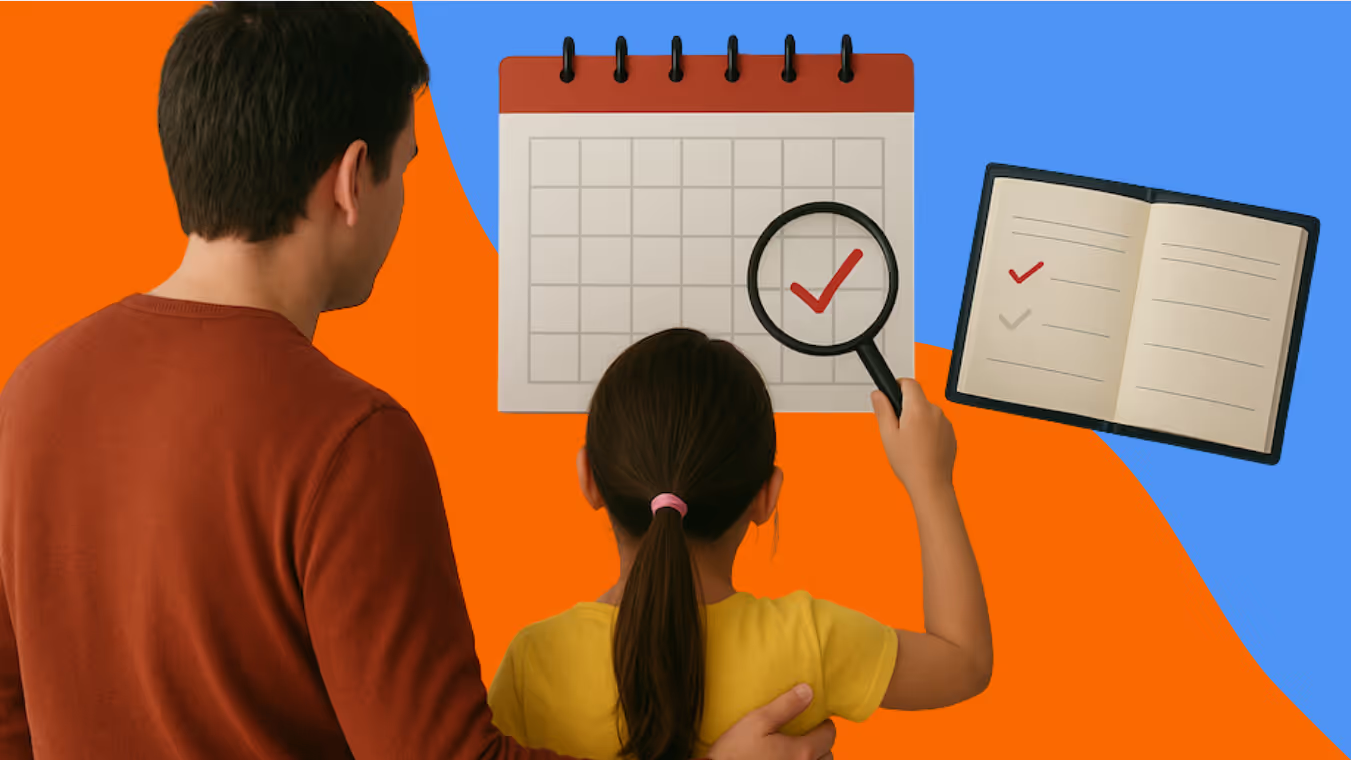
You’ve got the books, the pencils, the kitchen table cleared off — now what?
Planning a homeschool schedule might feel like trying to solve a jigsaw puzzle without the picture on the box for guidance. You have the freedom to create a rhythm that works for your kiddo, but with that freedom comes questions. How do I create a schedule that keeps my homeschooler engaged? How do I balance learning with time for creativity, exploration, and just the space to let my child be a kid? What if I don’t include enough learning — will they fall behind?
It’s a lot to figure out, but you don’t have to piece it together alone. Whether you're brand new to homeschooling or just looking to add more flow to your day, we’ll walk you through what to expect and how to create a schedule that works in real life.
Why do you need a homeschool schedule in the first place?
A homeschool schedule is not about creating a rigid routine that controls every minute of your day. Its purpose is to give your family a rhythm that works for everyone.
Structure creates freedom
When your kiddo’s day has a basic structure, it’s easier to make room for creativity, curiosity, and spontaneous learning. Because everyone knows what to expect, energy can go toward exploring instead of worrying about what’s next.
A schedule gives you the freedom to pivot. You can linger longer on a science experiment or take the afternoon outside because you know that you can always return to something familiar.
With the essentials covered, both you and your kiddo can stay present and engaged in the lesson at hand.
Build consistent learning habits
Think of learning like muscle memory; the more regularly kids practice, the easier it becomes. When their day has structure, they internalize when it’s time to focus, when it’s time to take a break, and how to move between the two.
Something as simple as “we always read after breakfast” or “math happens before lunch” becomes an anchor that keeps the day on track. With time, these patterns build independence as kids start to take ownership of their routines.
Reduce stress for parents and kids
Routines bring stability, both emotionally and mentally. A 2023 systematic review on Routines and Child Development found that consistent daily schedules help children develop better emotional self-regulation and reduce anxiety.
The predictability of a routine also means fewer power struggles, less resistance, and less stress for everyone, parents included. You’re no longer reinventing everyday or second-guessing if you’ve done enough. A steady daily routine helps you balance homeschooling with work, errands, and self-care.
Homeschool schedule by grade: What to expect
Your kiddo’s age, attention span, and developmental stage should naturally shape what the day looks like. The goal isn’t to copy a traditional school day, but to create a routine that they can actually enjoy and follow.
Here’s a general idea of what to expect at different grade levels:
Kindergarten and early learners (Pre-K–K)
Early childhood education is built on play-based learning, social-emotional development, and brief exposures to core academics. Your kiddo will grow most through games, stories, art, movement, and conversations.
According to CNLD Neuropsychology, the attention span for five to six-year-olds is roughly 12 to 18 minutes. That’s why short, flexible lessons work best. Aim to create a simple routine instead of a packed school schedule.
Mornings are typically when your little one has the most energy and focus, so it’s a great time for focused work or core academics. Afternoons can be for play or outdoor time to recharge their brains and bodies.
Lower elementary (Grades 1–2)
First graders and second graders are ready for a bit more structure. However, they still need variety, movement, and creative learning. At this stage, they’re beginning to build stronger skills in reading, handwriting, early math, and project-based learning.
Introduce group activities like reading together, doing simple science experiments, or working on a shared project. These opportunities give your child the chance to practice cooperation, patience, and empathy.
With every focus block, schedule short breaks that let your kiddo reset. These quick pauses help prevent burnout and make it easier for them to come back ready to learn.
Upper elementary (Grades 3–5)
By grades three to five, your child is ready to take on more challenges. They’re becoming more independent, able to focus longer, and interested in exploring subjects more deeply.
Their days usually consist of writing, reading comprehension, math practice, science, social studies, and enrichment subjects, such as art, sports, or music.
Plan for a few hours of academic work per day, but still tailor learning to your kid’s pace and personality. For example, some may prefer finishing harder tasks early, while others work best with alternating blocks of focus and physical activity.
A visual schedule or checklist can help your child practice time management and take ownership of their learning.
Middle school and beyond
Once your child reaches middle school, their cognitive development takes a big leap. They’re able to think more abstractly and critically about concepts, problems, and the world around them.
This stage is the perfect time to encourage longer blocks of independent study. Introduce weekly planning so your child can help map out assignments, projects, and goals.
Dedicate focused time to core subjects like math, science, and writing, and create opportunities for social connection through extracurriculars, sports, or study circles. Deadlines, rubrics, and assessments will also help them prepare them for the structure of high school and beyond.
Tips for planning a great homeschool schedule
Let go of the “perfect day” myth. There’s no perfect daily homeschool schedule, just the one that works best for your kiddo and family.
Set your priorities and expectations first
The most important part of creating a schedule isn’t what goes on it; it’s what you want to get out of it. Take a step back and ask: What matters most this year?
Maybe your biggest goal is to build confidence in reading. Or, maybe it’s to slow down mornings so your family feels less stressed and rushed every day. Your priorities will shape the way your day flows. Let your schedule reflect your core values and goals, rather than turning into a list of subjects to get through.
As a homeschooling parent, you’ll likely have to face the very real fact that your time and energy aren’t limitless. A homeschool schedule needs to serve your whole family, not just your child’s academics. That means considering your needs and bandwidth, too.
Start with year-long and weekly planning
Start with the big picture. Planning from the top down helps you stay grounded, avoid burnout, and build a routine that works in real life.
Map out the school year first, including all planned breaks, vacations, or family events. A year-round homeschool schedule helps you get a realistic view of how many weeks you’ll actually be teaching.
Then, divide the year into quarters, six-week blocks, or themed months. It’s easier to set goals, manage progress, and reassess each term. From there, move on to each week, and finally shape each day.
Remember to build in “grace weeks” where nothing new is scheduled, so both you and your kiddo have space to catch up, slow down, or rest.
Plan around your kiddo’s energy patterns
Kids aren’t supposed to sit and concentrate for hours on end. Their energy levels change throughout the day, or even depending on the day.
Observe when your kiddo is the most focused and pay attention to patterns like:
- When do they concentrate the best?
- How long does it take for them to become distracted or restless?
- Are there specific times they love reading, writing, or moving?
High-focus periods in a typical homeschool schedule can be reserved for tasks that need more brainpower, like problem-solving or introducing new concepts. Mid-energy windows are a great time for lighter tasks, such as handwriting or practicing familiar skills. Save low-energy periods for creative projects, physical activity, or personal interests.
Planning around these patterns helps with transitions between blocks and emotional regulation. You’ll also figure out why and when your child may feel more frustrated or unfocused, so you can respond with patience instead of pressure.
Schedule intentional breaks
Breaks are how kids process ideas, regulate their emotions, and refocus. Researchers from the University of Sydney found that even a simple five‑minute break from a demanding task is enough to restore concentration.
Breaks that involve physical activity stimulate the brain, support focus, and boost mood.
A study published by Minnesota State University Moorhead showed that 10 minutes of physical activity during lessons significantly improves focus, learning retention, and engagement.
Breaks help parents, too! Maybe you need space to reset and take a breather before you can jump back into teacher mode.
Adjust as you go
Life happens, and sometimes you need to pivot. Adjust your homeschool daily schedule based on what’s working and what’s not.
If something’s consistently feeling too rushed, too slow, or too chaotic, that’s a sign to make some changes. Melting down during a specific time of day or running out of steam before finishing math are cues that the current routine needs tweaking.
Small shifts can make big differences. For instance, you might move math earlier in the morning when energy is highest, add a snack break between subjects, or shorten a block that always feels overwhelming.
Homeschool schedule samples to get you started
Every family’s schedule will be a little different, but these examples of a typical homeschool schedule can give you a starting point:
Homeschool daily schedule
09:00–09:15 — Morning warm up
09:15–10:00 — Core subject 1: Math practice
10:00–10:15 — Short movement break with stretches
10:15–11:00 — Core subject 2: Reading comprehension
11:00–11:15 — Short break to reset
11:15–12:00 — Core subject 3 (rotating): Science exploration
12:00–12:45 — Lunch break
12:45–13:30 — PBL (Project-Based Learning)
13:30–14:00 — Daily reflection and SEL time
Homeschool weekly schedule
Monday
- Math: practice with word problems or timed drills
- Language arts: reading together + spelling practice
- Science: nature walk + journal observations
- Creative time: painting leaves or making a nature collage
Tuesday
- Math: multiplication and division practice
- Language arts: read aloud + grammar exercise
- Social studies: exploring maps
- Creative time: create your own map of your neighborhood
Wednesday
- Math: review fractions with manipulatives
- Language arts: write a short story, practicing punctuation
- Science: hands-on experiment (baking soda + vinegar reaction, or sink/float test)
- Creative time: music or movement activity
Thursday
- Math: word problems with real-world applications
- Language arts: word games (Scrabble, scavenger hunts)
- Social studies: cultural studies about different cultures and their traditions
- Creative time: storytelling, drama, or puppet show
Friday
- Math: review games (flashcards, Kahoot, or board games with math)
- Language arts: independent reading time
- Science or project day: STEM challenge (build a bridge with straws)
- Creative showcase: finish weekly projects + weekly reflection
Year-round homeschool schedule
Term 1 (Weeks 1–12)
Math: review and strengthen basics
Language arts: daily reading + short writing/journaling
Science: nature study, simple experiments
Social studies: maps, family history, or local community
Goals:
- Build a steady routine with math practice.
- Read aloud together at least 15 minutes a day and begin writing two to three complete sentences in a journal.
- Complete a family tree or neighborhood map project to connect learning with real life.
Term 2 (Weeks 13–24)
Math: move into new concepts (multiplication, fractions, problem-solving)
Language arts: comprehension, spelling, grammar basics, longer writing pieces
Science: weather, earth science, or life cycles
Social studies: early history or world geography
Goals:
- Begin mastering multiplication facts up to 12 × 12.
- Write one longer piece of writing per week, with proper grammar and punctuation.
- Read a chapter book independently and summarize the main events orally.
Term 3 (Weeks 25–36)
Math: real-world math (money, measurement, word problems)
Language arts: creative writing, presentations
Science: project-based learning (ecosystems, machines, human body)
Social studies: cultural studies, traditions, or comparing countries
Goals:
- Practice using money in real-life situations.
- Practice organizing ideas and speaking confidently.
- Complete one hands-on science or social studies project.
Want a schedule without the stress? Meet bina
You don’t have to stress about building the perfect schedule — bina is a full-day, live, online school for kiddos from four to 12.
Every day, your kiddo will join interactive online lessons in small groups. Our small class size (up to eight students) means our teachers get to know your child and adjust the schedule based on their needs, pace, and interests.
Lessons happen through project-based learning where students dive into themed biomes (like oceans, deserts, or rainforests), explore big questions, and come up with creative solutions to real-world problems.
There are also built-in social opportunities, from group projects and class discussions to games and peer sharing. Social-emotional learning is woven into the routine with daily check-ins and SEL activities to help our students practice self-awareness, empathy, and resilience.
If you’re looking for a full-day online school for your kiddo, bina might be the right fit for your family. No more piecing things together, just a plan you can trust.
Accredited, full-time school for grades K-12
Bring the best of the classroom to your home
See if we're a fit

More to read
How to plan a 1st-grade homeschool schedule for your kiddo
Create a 1st-grade homeschool schedule that balances reading, math, projects, and everyday life. Get simple tips to help your kiddo learn, grow, and shine.



How to create a summer homeschool schedule that sparks learning
Learn how to build a summer homeschool schedule that keeps learning fun and flexible. Explore sample routines, tips, and examples.

How to plan a 3rd-grade homeschool schedule for your kiddo
Learn how to plan a 3rd-grade homeschool schedule with balance. Get tips, examples, and daily schedules that mix academics, projects, and play.