Homeschool burnout: a guide for parents doing it all
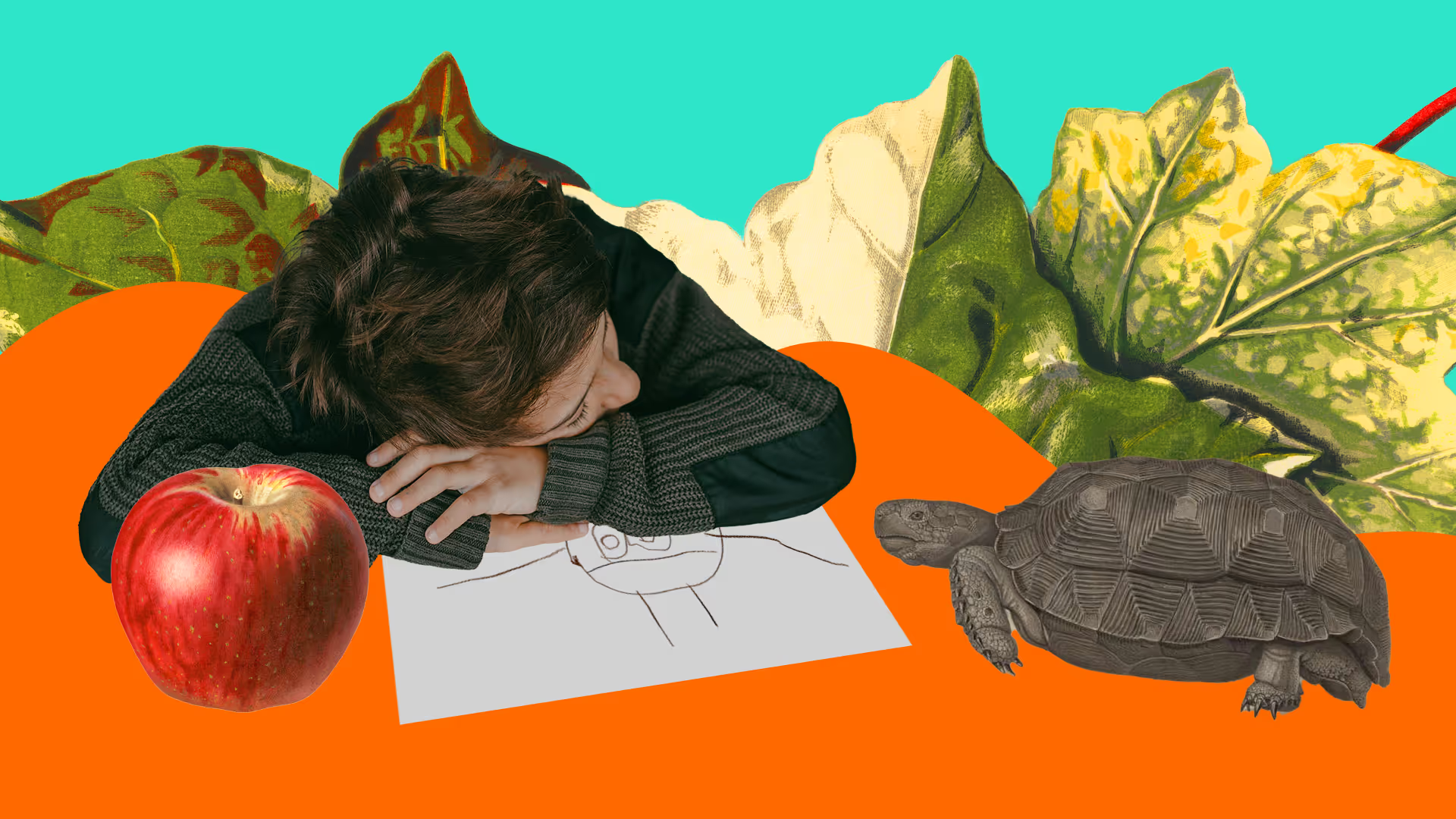
Many families choose homeschooling because it aligns with their vision for raising their children, centered around connection, flexibility, and a more intentional pace of learning. It’s a personal decision, often rooted in deep care.
That’s also why it can be so destabilizing when it starts to feel like more of a burden than a pleasure. Many parents don’t recognize burnout at first because it doesn’t always look the same way. Sometimes it can be a sense of quiet dread before the day begins. Or a short temper that feels harder and harder to control. Or the creeping feeling that, even though you’re trying your best, something fundamental is slipping.
This is what researchers refer to as homeschool burnout - a specific, identifiable pattern of emotional and physical exhaustion that arises when the daily demands of home education consistently exceed the support structures in place. It is not the same as occasional stress. And it is not a personal failure on your part, no matter how challenging it can feel.
Why homeschooling your child can be harder than you envisioned
Burnout has been studied for decades in workplace settings, but its impact on homeschooling parents is only now being more widely recognized. What begins as a season of clarity, full of commitment, purpose, even joy, can shift, often gradually, into something far more difficult to name.
The source of this burnout often lies in parents like you experiencing competing demands and overlapping responsibilities. Homeschooling parents are managing instruction, emotional care, household responsibilities, and in many cases, paid work simultaneously. This takes place at the same time and in the same physical space, without clear boundaries or breaks. All that can lead to this feeling that there's no natural stopping point, and not enough support to help you juggle all of the responsibilities of your multiple roles at once.
In response to early signs of struggle, many parents do what they’ve always done: work harder. They double down on the curriculum, or try to add more structure and tighten expectations. You might find yourself thinking, "If I can just get over this hurdle, then things will get easier", and then stretch yourself even further, only intensifying the strain on yourself and your child. The result of that is clear. Children, sensing the pressure, may become more resistant or withdrawn. Parents, exhausted and unsure, begin to question their ability to lead. And the cycle continues quietly and persistently until burnout takes hold.
And although every homeschool journey is different, the patterns reflecting burnout manifest in the same way. But how can you tell if you're at risk of burning out?
The quiet toll of trying to do it all on homeschool families
Burnout doesn’t always announce itself. It often builds gradually through small compromises in your homeschool routines. But over time, the signs become harder to ignore. If several of the following feel familiar, it might be time to pause and take stock:
- You feel persistently exhausted, no matter how much you rest
- You find yourself losing patience more quickly than you used to
- Mornings feel heavy like the day is already getting away from you before it begins
- You’ve lost the sense of peace and joy or even momentum, that you once had in homeschooling
- You question whether you’re actually equipped to keep going in this role
- Thoughts of quitting, or longing for a conventional school setting, surface more often
- Routines feel hard to maintain, and changes to the plan throw everything off
- You say yes when you mean no, and your own needs fall to the bottom of the list
- You feel an edge of resentment toward homeschooling itself
- Your body is showing signs: disrupted sleep, tension, fatigue that doesn’t lift
These patterns are signals that show up when the emotional, mental, and physical demands of home education start to outpace the support structures around you. And they’re more common than you think. Most triggers for burnout fall into three overlapping categories:
- Overextension: Managing academics, household tasks, family schedules, and sometimes paid work, all at once.
- Lack of boundaries or support: Homeschooling often blends into every moment. There’s no off switch, few breaks, and little adult social interaction to reset your energy.
- Expectations and comparison: Pressure to meet arbitrary standards for your child or yourself can fuel guilt, self-criticism, and emotional exhaustion.
If this resonates, the next step isn’t guilt. It’s strategy: letting support in, recalibrating routines, and caring for yourself with the same attention you give your child.
Beating homeschool burnout: a strategy for success
Don't allow yourself to think that burnout means you’ve failed. It doesn't. It simply means that your current setup is no longer working for you, and that your mind and body are asking for something different. The good news is that the path forward doesn’t require an overhaul. It begins with small, steady shifts. Here are a few changes you can start making today:
1. Simplify and prioritize
It’s easy to feel like you need to do everything to the absolute best of your ability. But often, what helps most is doing less, more intentionally. Start by shortening lesson times with scheduled breaks in the middle, prioritizing them over full-day structures. Let go of subjects or activities that aren’t serving your child right now. Your homeschool doesn’t have to look like anyone else’s to be effective.
2. Set clear boundaries and daily rhythms
Burnout thrives in that blur when school never really starts or ends, and no space is fully off-duty. Create a gentle but firm container around your day: a time to begin, a time to stop, a rhythm that supports both learning and rest, and a space that separates class time from downtime.
3. Take your needs seriously
You can’t give what you don’t have. Schedule breaks the same way you schedule lessons. Prioritize sleep, hydration, nourishment, and movement. These aren’t luxuries. They’re the baseline that makes everything else possible.
4. Connect with others
Isolation is a fast track to burnout. Remember, you do not need to do this on your own. Nor do you need to exclusively speak with others in the same boat as you. Reach out to friends, family members, or even that nice lady you met on your morning dog walk. Talk about something else, and don't be shy to ask for help.
5. Use tools that lighten the load
Not every lesson has to be designed from scratch. Lean on ready-made curricula or online tools when your energy is low. Education technologies are starting to thrive, and you can lighten your own load by embracing them. Some of these powerful, flexible tools built to support home education include:
- Khan Academy - offering free, high-quality lessons in math, science, and more. It's completely self-paced, with built-in guidance and tracking tools.
- Outschool - connecting learners with live, small-group classes across everything from fractions to storytelling, giving you a breather without compromising engagement.
- Prodigy - turning math into a game, while keeping your child’s skills sharp, while you catch your breath.
- Epic! - providing access to thousands of books in one place, perfect for independent reading time.
- Homeschool Planet - helping you take some of the mental load off by organizing your week, your records, and your multiple roles.
6. Acknowledge what’s working
Burnout distorts your sense of progress, so take time to notice what’s going right. A calm exchange. A concept that clicked. A moment of laughter. Every win counts.
7. Reconnect with your “why”
When the weight of the day feels too heavy, return to the reason you chose this path. Not the perfect version of homeschooling you imagined, but the real, human intention underneath it. That clarity won’t solve everything, but it can anchor you when everything else feels loose.
A compassionate alternative: how bina can help
If, after much reflection, you feel as though juggling homeschooling, parenting, and work is too challenging, but wouldn't like to return your child to traditional schooling, there is another way. bina is a full-time online school designed to preserve the flexibility and values that drew you toward homeschooling while easing the burden on your day-to-day life. Here's how:
We run live classes led by experts
With bina, your child attends live online lessons in small groups ranging from six to eight students at most, and led by experienced, master educators trained in precision education. These aren’t pre-recorded lectures; they’re interactive sessions, rich with hands-on projects, social-emotional learning, and group collaboration that bring lessons to life.
All learning at bina is personalized, without the pressure on you
bina’s model includes ongoing assessment and adjustments to match each child's unique strengths, learning styles, and emotional needs, so your child learns at the right pace and isn't left behind. Parents aren’t the teachers, but they stay close by, supporting routines without being required to instruct.
Our structure frees you up for other pursuits
You decide how involved you need to be. Most parents can step away once their child’s learning space is ready. That means you can focus on your work, your self-care, or just catching your breath, knowing your child is engaged and supported.
We offer stability for any type of family
Whether you’re traveling, commuting, or balancing work schedules, bina provides a steady routine and consistent learning environment. Your child joins the same class from anywhere in the world, with an accredited curriculum backed by international standards.
Social-emotional learning is given a front seat in your child's education
Every day, emotional well-being is woven into lessons. Students pause to reflect, connect, and collaborate, strengthening empathy, resilience, and interpersonal skills, something research shows is essential for long-term growth.
Why families like yours find bina restorative
For many families, discovering bina feels less like giving something up and more like finally getting room to breathe. The constant pressure to design every lesson, manage transitions, and keep the momentum alive fades into the background. Instead, you get to step into a new role - not as the sole driver of your child’s education, but as a steady, supportive presence beside them.
Your child still learns at home, in a space that feels familiar. But now, they’re part of something consistent and carefully designed. The curriculum is rigorous and accredited, and the instruction is warm and responsive. Their teachers understand how your child learns best and adjust in real time to meet them there.
And perhaps most powerful of all: your child builds a classroom community with peers around the world. They show up to the same faces, the same teacher, the same rhythm, no matter where your family is. That sense of consistency, of belonging, is something many parents say they didn’t realize they were missing until they saw it in action.
Choosing bina isn’t a retreat from homeschooling. It’s an evolution. A way to preserve what matters, while making space for what’s sustainable
It’s okay to choose ease
Burnout doesn’t mean you’ve failed—it means you’ve been carrying more than one person should. If homeschooling no longer feels sustainable, that’s not a sign to push harder. It’s a sign to pivot with care. Whether you adjust your routines, seek more support, or explore a new path like bina, what matters most is that your family’s learning journey works for all of you. You’re allowed to change course. You’re allowed to choose ease. And you’re still the right parent for your child, especially when you make space for your own well-being, too.
Accredited, full-time school for grades K-12
Bring the best of the classroom to your home
See if we're a fit

More to read
Secular homeschool curriculum resources for elementary-aged kids
Learn what a secular homeschool curriculum is and why it may be a good match for your child. Plus, the top resources for parents.



Summer homeschool curriculum ideas without school-at-home
Summer often gives parents a clearer picture of how their child actually likes to learn. Some children suddenly read for fun again. Others become more…



The 7 best homeschool reading curriculum options in 2026
Teaching your child to read is one of those core parenting moments you'll remember forever. That feeling you get when they first decode a word or read…