Why elementary schools with small class sizes matter
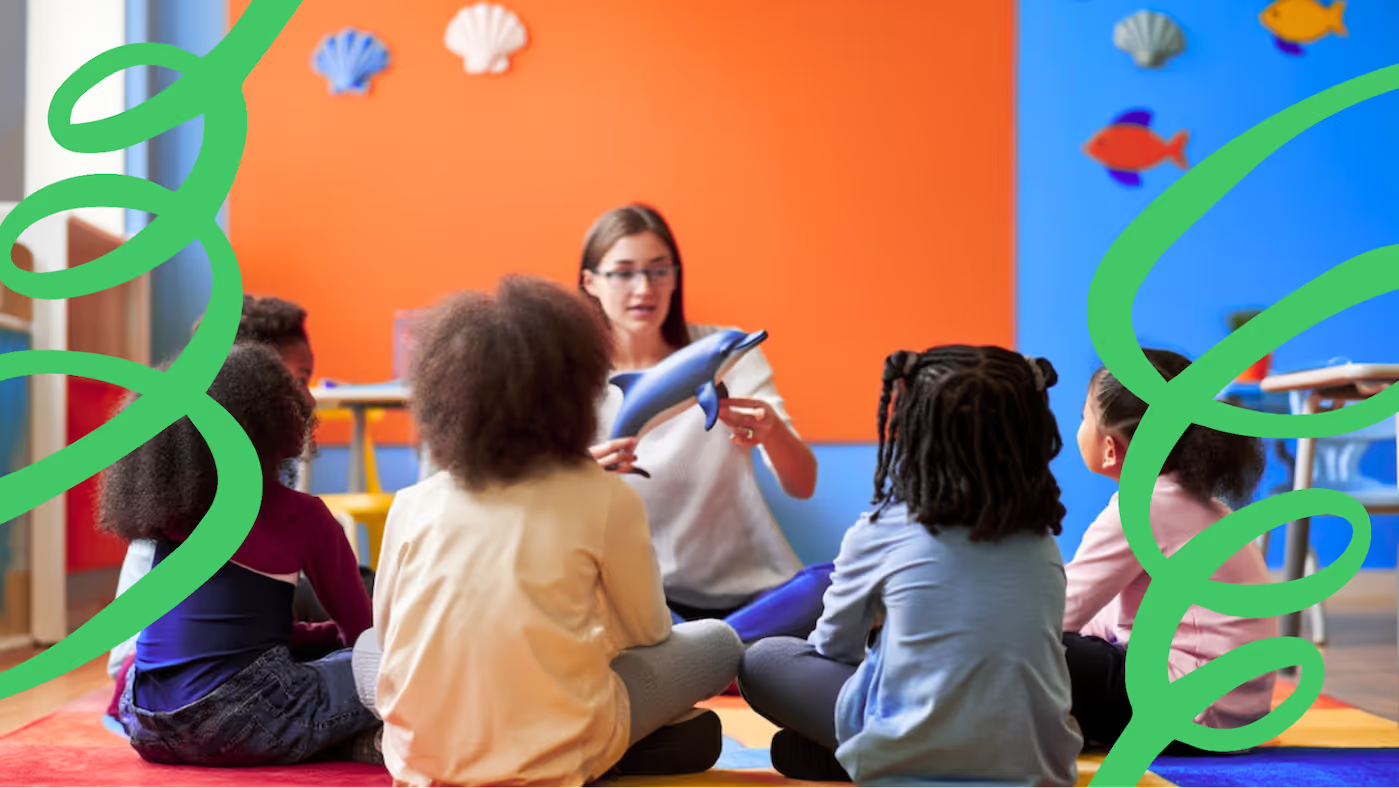
If you’ve ever peeked into a packed classroom and thought, “How on earth does one teacher manage all that?” you’re already thinking about one of the biggest things that affects how your child learns — class size.
The number of kids in the room shapes everything, from how much personalized attention your child gets to how connected they feel at school.
In this guide, we’ll break down why small classes make such a big difference, what actually counts as “small,” and how to find schools that offer that more personal, less-crowded kind of learning.
Why small class sizes matter for elementary learners
In the early years of school, attention spans are short, curiosity runs wild, and emotions are always close to the surface. Kids are still figuring out how to sit through a story, wait their turn to talk, and bounce back when something feels tricky. When one teacher has too many little personalities to guide, it’s easy for quiet kids to fade into the background, or for the louder ones to take up all the air.
Smaller classes change that. With fewer students, teachers can give each child the focus they deserve, spotting early reading struggles and celebrating small victories. The day runs more smoothly, routines feel gentler, and kids feel safe to ask, try, and learn.
When classes are small, teachers don’t just teach — they connect. They get to know how each child learns best, what sparks their curiosity, and when to offer a helping hand. That kind of one-on-one attention builds confidence as much as it builds skills.
One of the best-known studies on this topic, the “Tennessee STAR (Student–Teacher Achievement Ratio) experiment,” found that children in smaller classes performed better in reading and math than those in larger classes — and the benefits lasted for years. Teachers also became more effective, and students were more engaged, especially in the early grades when those foundations matter most.
What is considered a “small class size” in elementary school?
“Small” in terms of class size is a pretty vague term, and it means very different things depending on where you are in the world. Globally, the average elementary classroom has about 24 students, according to EBSCO Information Services data. But the range is wide: countries like Belgium and Estonia average closer to 17, while places such as Singapore reach 35 students per class. In France, the average is around 22, and in the United States, about 21.
So what actually counts as small? In general, 15 students per teacher is considered a small class, the kind where a teacher can know each child by name, learning style, and personality.
But it’s not just about headcount. Ratios matter too. A class of 12 kids with both a lead teacher and an aide can feel more personal than a class of 15 with only one teacher. It’s that extra pair of eyes and hands that make small classes full of learning moments that might otherwise slip by.
Types of elementary schools known for small class sizes
Small classes aren’t just the domain of fancy private schools anymore. From Montessori to live online classrooms, more schools are proving that fewer desks can mean deeper learning and more confident kids.
Private schools focused on academic performance
Private schools are often known for their smaller classes, but some take that idea further, intentionally keeping numbers low to boost academic performance. They can cap enrollment and shape an environment that feels personal and focused on achievement.
The teaching approach often leans toward individual attention, enriched subjects, and relationship-driven learning. Teachers have the flexibility to slow down or stretch lessons based on the students. They don’t have to fly through the curriculum and finish the syllabus.
Most private elementary schools average around 10 to 18 students per class, compared to 20 or more in many public schools. Some go even smaller. At Westbourne School in Wales, UK, classes are capped at 18 kids per class in Reception to Year 5, with an 8:1 pupil-to-teacher ratio. Similarly, at Rowland Hall in Salt Lake City, Utah, Lower School classes average around 15 students with a 9:1 ratio.
Live online schools
Live online schools are redefining what “small class size” means. Instead of packing dozens of kids into a physical room, these schools bring them together virtually. In tight-knit live sessions, teachers can give individual attention without the distractions of a crowded classroom.
Lessons are interactive (not pre-recorded videos), and teachers are trained to spot who’s thriving and who might need an extra nudge of encouragement.
At bina, for example, each class has just six to eight students and two educators. That small number makes it possible for teachers to adjust the pace in real time and give daily feedback. Kids feel comfortable asking questions, sharing ideas, and building friendships, even across continents.
For families who travel, live remotely, or simply want a more individualized approach, small online classes offer the best of both worlds. They have the focus of a private school but the flexibility of learning from home.
Montessori schools
Montessori classrooms are recognizable by the way kids explore at their own pace and take ownership of their learning. Kids move around the room choosing activities and working with their hands. The basis of the Montessori philosophy is independence, exploration, and respect for each child’s natural rhythm.
To make that possible, Montessori schools keep classes small and well-supported. Most elementary Montessori classrooms have about 15 to 20 students, often with a lead teacher and an assistant. The mixed-age setup, where younger and older students learn side by side, also means that teaching happens in smaller, fluid groups rather than one teacher lecturing from the front.
At Cornerstone Montessori School in Surrey, Canada, for example, classes range from 12 to 18 students, depending on the level. With fewer students, Montessori teachers can move freely around the room, quietly observing, offering materials, or guiding one child at a time. The result is a learning environment that feels peaceful yet productive, where every child can follow their curiosity.
Waldorf schools
Walk into a Waldorf classroom and you’ll instantly feel that it’s slower, softer, and deeply human. There are no rows of desks or flickering screens. Instead, you’ll find storytelling, art, movement, and a strong sense of rhythm to the day.
Waldorf education is built on connection, creativity, and continuity. Teachers often stay with the same group of students for several years, becoming almost like an extended family.
To nurture that connection, class sizes stay intentionally small. Most Waldorf elementary classes average around 16 to 20 students, though some start even smaller in the early years. At Corvallis Waldorf School in Oregon, for example, kindergarten groups have just 16 to 18 children, and lower grades are capped at around 20 to 22.
The idea is simple but powerful: when a teacher really knows their class, not just academically but personally, children feel safe to take risks and express themselves. In small, stable groups, learning feels less like schoolwork and more like a shared journey.
Project-based or progressive schools
Project-based and progressive schools focus on learning by doing. They blend subjects into real-world projects instead of separating everything into neat textbook boxes. Lessons often spill out of the classroom into gardens or the community.
To make this kind of hands-on learning work, classes need to stay small. Teachers act more like mentors, guiding groups of 10 to 18 students through collaborative projects where every child has a voice and a role. The emphasis is on teamwork, creativity, and critical thinking rather than test scores.
Alma Forest School, a progressive nature-based school in Sotogrande, Spain, keeps its early grades small with a maximum of 15 students per class. The low numbers make it easier for teachers to nurture curiosity, creativity, and a deep connection to the natural world.
What to look for in elementary schools with small class sizes
When comparing elementary schools for your kiddo, it’s easy to get swept up in the numbers. “Twelve kids per class — that sounds amazing!” But small class sizes only really matter if what’s happening inside that small group is thoughtful, engaging, and supportive.
Here’s what to pay attention to when you’re researching or touring schools:
Ask about the average class size by grade, not the maximum
Some schools will tell you “up to 18 students,” but that might mean the real number is closer to 22 once the year gets going. Ask what the typical class looks like in your child’s grade right now.
Look beyond the headcount — who’s in the room?
A class of 15 with one teacher feels very different from a class of 15 with a teacher and an aide. Check whether the school has extra support staff or specialist teachers for art, music, or social-emotional learning.
Watch how kids interact
If you visit during class or peek at an online session, notice how many kids are participating. Are they raising hands, chatting, and asking questions? Or are just a few voices dominating? In a small, well-run class, more teacher-student interaction means everyone gets a turn to shine.
Pay attention to the energy
Does the classroom feel calm and connected, or hectic and noisy? Every child is different — some thrive in a quiet, focused space, while others need a bit of peer energy to stay engaged. Picture your own child there. Would they feel comfortable?
Ask how teachers use small class sizes
Small class sizes are only part of the equation. What really matters is how teachers turn that extra breathing room into deeper learning, stronger peer relationships, and a classroom where every child feels like they belong.
They might tailor lessons for different learners, run small group projects, or have daily SEL check-ins to build empathy and confidence.
bina: where small class sizes mean big learning
At bina, small classes aren’t a perk. They’re the heart of how learning happens. Teachers have the time to really get to know each child’s quirks, strengths, and spark. That closeness means feedback is more personal, friendships grow faster, and lessons flow at a pace that suits the kids in the room.
Our certified teachers tailor learning, adjusting the depth and pace in real time. And even though our classrooms are online, they’re full of warmth, laughter, and SEL check-ins. With students from all over the world cheering each other on, learning at bina feels calm, collaborative, and full of joy.
FAQs
What is considered a small class size for elementary school?
Usually, anything under 15 students per teacher is considered small. That’s where teachers can really give each child focused attention.
Do smaller class sizes always mean better education and higher academic achievement?
Smaller classes help teachers connect, support, and guide kids more personally, but they’re only part of the equation. What really makes the difference is how that time is used. Strong teaching, an engaging curriculum, and a caring classroom environment matter just as much.
Are small class sizes only available in private in-person schools?
Not anymore. While many private schools are known for smaller groups, more public charter schools and live online schools (like bina) now offer intimate, small-group learning, too.
How does a small class size impact social skills?
In smaller classes, every child has a voice. Kids get to share ideas, listen to others, and work together, all skills that build empathy, confidence, and teamwork. There’s also less pressure, so friendships and collaboration come more naturally.
Accredited, full-time school for grades K-12
Bring the best of the classroom to your home
See if we're a fit
More to read
Alternative school meaning, explained for parents
From online learning to project-based models, find out what alternative school really means, and why more families are choosing this flexible path.

Why kids need elementary school social emotional learning
Learn why elementary school social emotional learning is important and how innovative schools like bina deliver what traditional schools can’t.
4 ways your kiddo can benefit from an online international school
Enrolling your child in an online international school means flexibility, and your kiddo learns in a diverse environment. Find out more benefits.