Alternative school meaning, explained for parents
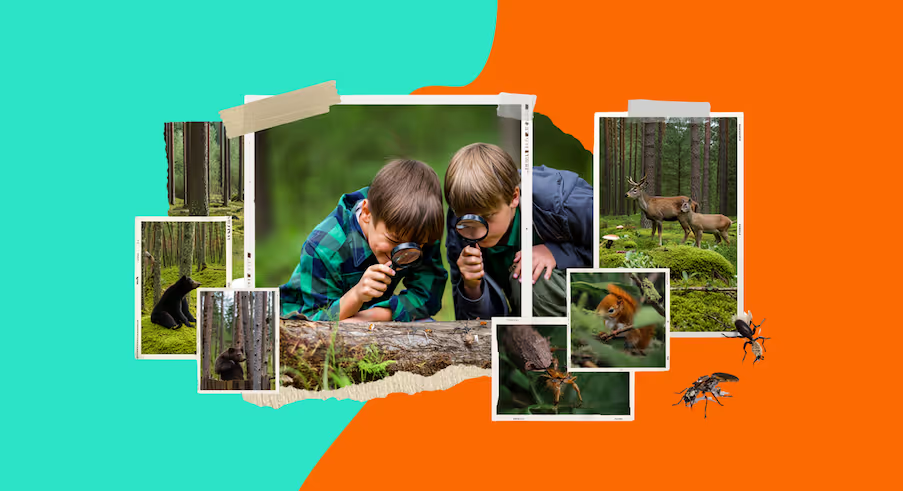
Not every child fits the mold, and not every school should either. That’s where alternative schools come in. They’re built for kids who learn differently, think creatively, or just need something beyond the standard classroom setup.
In this guide, we break down what “alternative school” really means, how it compares to traditional schooling, and why new options like bina are rethinking what education looks like.
What does “alternative school” actually mean?
When looking for an alternative option to public school, you might think alternative means a private school with smaller class sizes. Or maybe a program for kids who struggle in traditional classrooms. But rather than one fixed model, “alternative” is really a mindset focused on rethinking what school can be.
Alternative education is about breaking away from standardized systems that treat every child the same. It’s a broad category of schools and programs that prioritize:
- Student agency and choice, giving kids more say in what and how they learn
- Hands-on, project-based learning instead of lectures and worksheets
- Emotional and social growth as part of the curriculum
- Real-world relevance so learning feels meaningful, not just test-driven
Some alternative schools are public (like charter or magnet schools), some are private, and others are online or unaccredited. What connects them all is the belief that education should work for the child, not the other way around.
Why families choose alternative schools
More and more families are realizing that pushing kids through the traditional school system isn’t doing anyone any favors. That’s why parents are exploring alternative options to public school that better support their child’s learning, mental health, and growth.
In the UK, for example, parents are increasingly choosing to withdraw their kids from mainstream schools, often due to gaps in mental health and SEND support (support for special education needs or a disability). That shift is fuelling a rise in homeschooling and online alternatives.
Every family’s story is different, but the reasons usually fall into a few common themes.
Burnout and anxiety are real
Has your kid ever come home from school completely drained? Not from learning, but from trying to keep up, stay still, or fit into a box that just isn’t made for them. Psychologists report that forcing children into unsuitable settings “can cause chronic stress, leading to severe burnout.”
In these cases, alternative schools may be a better fit. They often create calmer, more supportive environments where kids can be themselves and thrive academically.
Gifted, twice-exceptional, and neurodiverse kids need flexibility
When a kiddo is ahead in some areas and needs more support in others, traditional classrooms can feel either too slow or too rigid. Alternative schools often allow students to move at their own pace and focus on their strengths, rather than just their areas for improvement. That’s a game-changer for kids who are gifted, on the autism spectrum, or have ADHD.
Schedule flexibility for busy lives
Whether your kiddo is a young actor, competitive swimmer, world traveler, or just doesn’t function well at eight in the morning, alternative schools often offer more flexible schedules. Online and hybrid models in particular make it easier to fit school into your life, not the other way around.
Emotional support is part of the plan
Some alternative schools are built specifically for kids who’ve experienced bullying, trauma, or mental health struggles. In the UK, schools like Mulberry Bush offer residential programs focused on emotional healing, and small therapeutic centers like Red Balloon offer real emotional support alongside the usual subjects. In the US, schools like Jackson Community School combine small class sizes with whole-child care. It’s about creating a space where kids feel safe enough to learn.
It fits your family’s values
Not every family wants their child’s education to be all grades.
Some parents are drawn to nature-based learning. Others love the idea of self-directed education or project-based models that feel more connected to real life. Whether it’s a forest school outside London, a creative arts school in Boulder, or an unschooling co-op in Portland, these options exist because not every family wants their child’s education to be all grades and grind.
Examples of alternative schools
So what does an alternative school actually look like? That depends. Some kids need freedom, while others need structure. Some parents want nature; others want tech.
Below, you’ll find a mix of real schools from around the world across different age groups, formats, and philosophies.
Online alternative schools
For families who want structure and flexibility, an online alternative school could be the perfect fit. Whether you’re traveling, living abroad, or want something more tailored to your child’s pace, these programs make it easier to stay on track academically while fitting school into your family’s lifestyle.
bina
A fully online, live-taught school for kids aged four to 12, bina isn’t adapted from older models. The curriculum is designed from scratch to meet the developmental needs of children from day one. With students from around the world, bina offers daily structure, small class sizes, a focus on social-emotional learning, and real teacher connection, making it feel like an in-person classroom, without the commute.
Sora Schools
A US-based online school for middle and high schoolers, Sora ditches traditional classes for real-world projects and personalized learning paths. Students might spend their term designing a video game or working with mentors on entrepreneurial ventures.
There are no grade levels. Instead, learners progress based on goals, interests, and skills. It’s a flexible, future-focused school where kids learn by doing.
Fusion Global Academy
Fusion is a private online school where every class is taught live, one-on-one, just the student and the teacher. It’s designed for middle and high schoolers who need flexibility, thrive in a more personal setting, or benefit from extra emotional support. The schedule is fully customizable, and the vibe is more like a supportive mentorship than a traditional classroom. For teens who feel lost in the crowd or need a gentler pace, Fusion can be a game-changer.
Charter schools
Charter schools are publicly funded but independently run, and many use that freedom to rethink how school should work. Here are a few that stand out:
High Tech High (San Diego, California)
High Tech High turns the idea of school on its head. Located in San Diego, it trades textbooks and lectures for real-world projects, teamwork, and problem-solving. Students design, build, and present their work just like professionals so that learning feels connected to life beyond the classroom.
Summit Public Schools
With campuses across California and Washington, Summit focuses on helping students set personalized learning goals and reach them. Each learner gets their own roadmap, guided by teachers and mentors, with tech tools that support progress and independence every step of the way.
SLAM! (Miami)
SLAM! (Sports Leadership and Management) is a tuition-free public charter school in Miami, co-founded by the rapper Pitbull. There’s a strong focus on media, broadcasting, and sports. The vibe is high-energy and community-driven, giving underserved students access to both cultural relevance and real-world career prep.
Creative and arts-based schools
For kids who think, express, and learn through creativity, these schools let the arts take center stage.
The New School of Northern Virginia
This liberal arts private school blends rigorous academics with student-directed projects. Teens might spend a semester writing a novel, staging a play, or conducting a social justice research project. Teachers act more like collaborators, and students have a say in what and how they learn. It's ideal for kids who need room to think big and dig deep.
Chicago High School for the Arts (ChiArts)
ChiArts is part high school, part conservatory. Students get pre-professional training in dance, theatre, music, or the visual arts — with academics woven in. Mornings are spent in core subjects; afternoons are dedicated to intensive arts instruction. The schedule is demanding, but for young artists, it’s a dream setup.
Brightworks
Brightworks is both a school and a makerspace. At this independent K-12 school in San Francisco, there are no traditional subjects or classes. Instead, kids work through “arcs” or long-term projects based on a theme, like flight, cities, or identity. One child might be designing a treehouse; another could be interviewing community leaders. There’s a huge emphasis on tinkering, collaboration, and learning through curiosity.
Nature-based and international examples
These alternative schools are for families who believe the best classroom might be outside under trees, not fluorescent lights.
The Acorn School (London, UK)
A Waldorf-inspired nursery and kindergarten, the Acorn School uses forest learning, creative play, and seasonal rhythms to guide early childhood development. It’s almost entirely screen-free, with children spending hours outdoors each day, building dens, baking bread, and learning through hands-on exploration. Acorn is gentle, slow, and deeply rooted in nature.
Kinma (Sydney, Australia)
Kinma is a democratic school where students help shape the learning experience. There are no grades, no standardized tests, and no set curriculum. Just a lot of trust in children’s ability to lead their own learning journeys. The school is small and multi-age, with an emphasis on collaboration, creativity, and emotional wellbeing.
The Living School (New Orleans)
This alternative school is all about “place-based learning,” meaning education is built around the city itself. Students engage with New Orleans’ culture, the environment, and the community as part of their curriculum.
The focus of The Living School is on justice, sustainability, and holistic growth. The program includes things like service projects, neighborhood mapping, and cooking from local gardens. It’s learning that’s as rooted in values as it is in academics.
Unschooling-style
Looking for a completely different approach that turns the traditional school day upside down? Unschooling options focus on helping kids think for themselves. They’re problem-solving, playing, and discovering through project-based learning.
PS1 Pluralistic School (Santa Monica, California)
PS1 is built around the idea that diversity of thought, age, and learning style makes for better education. Students work in mixed-age groups and are encouraged to pursue questions and creative ideas across disciplines. The learning is guided, but it’s not top-down. There’s a lot of choice, trust, and room to be yourself.
North Star (Massachusetts, USA)
North Star isn’t a school, technically. It’s a self-directed learning center for teens who’ve left school entirely. There are no mandatory classes, no grades, and no set curriculum. Instead, students get coaching, resources, and access to workshops or mentorship based on what they want to explore. Some go deep into music, others study philosophy, and others work part-time or take college classes. It’s total freedom, with adult support.
A new kind of school for a new kind of learner
Alternative schools are a step in the right direction — more flexibility, more heart, more focus on the whole child. But let’s be honest: a lot of them are still just traditional schools in disguise, with slightly smaller classes or a gentler tone.
bina takes it further.
bina is a fully online school built from the ground up for kids aged four to 12. School is not adapted for them — it’s designed for them. Every class is live, interactive, and taught in small groups by real teachers who truly see and support each student.
It’s not homeschooling. It’s not a part-time add-on. And it’s definitely not a collection of pre-recorded videos you have to nag your kid to watch. bina is a full school day — structured, engaging, and rooted in what works for young learners: connection, curiosity, and creativity.
If your child hasn’t quite fit the mold, or if you’re simply looking for a school that puts your child’s growth (not just grades) first, bina might be exactly what you’ve been searching for.
We’d love to hear about your child and help you explore your options. Get in touch with the bina team and see if we’re a good fit for your kiddo.
FAQs
Are alternative schools only for kids with behavior problems?
No. Some alternative schools do support students with behavioral or emotional challenges. Many serve gifted kids, neurodiverse learners, or students who simply don’t thrive in traditional classrooms.
How is an alternative school different from a private school?
Private schools can be traditional or alternative, depending on their teaching approach. The key difference is that alternative schools focus on flexible, student-centered learning, whether they’re public or private, online or in-person.
Can my child still transfer to a traditional middle or high school later if they start with an alternative elementary school?
Yes, they can. Programs like bina follow a structured, accredited curriculum designed to keep your kiddo on track with core academic standards. That means if or when they’re ready to move back into a traditional school system (locally or abroad), you'll have everything you need for a smooth transition. Many bina families go on to place their children in top middle schools around the world.
What is the best age for an alternative school?
Alternative schools are available for all age groups, ranging from early childhood through high school. Some, like bina, are designed specifically for younger learners (ages four–12), which is rare in this space.
Accredited, full-time school for grades K-12
Bring the best of the classroom to your home
See if we're a fit
More to read
Alternative school program options for every kind of learner
Explore alternative school programs like Montessori, Waldorf, online schools, and more. Find the right fit for your child’s needs and learning style.

Why elementary schools with small class sizes matter
Discover why small class sizes matter in elementary school, what “small” really means, and how to find a close-knit learning environment for your kiddo.
Private homeschool programs or private online school?
Considering private homeschool programs? Learn why more families are choosing private online schools for a structured and accredited education.