Finding the best homeschool curriculum: A personalized approach
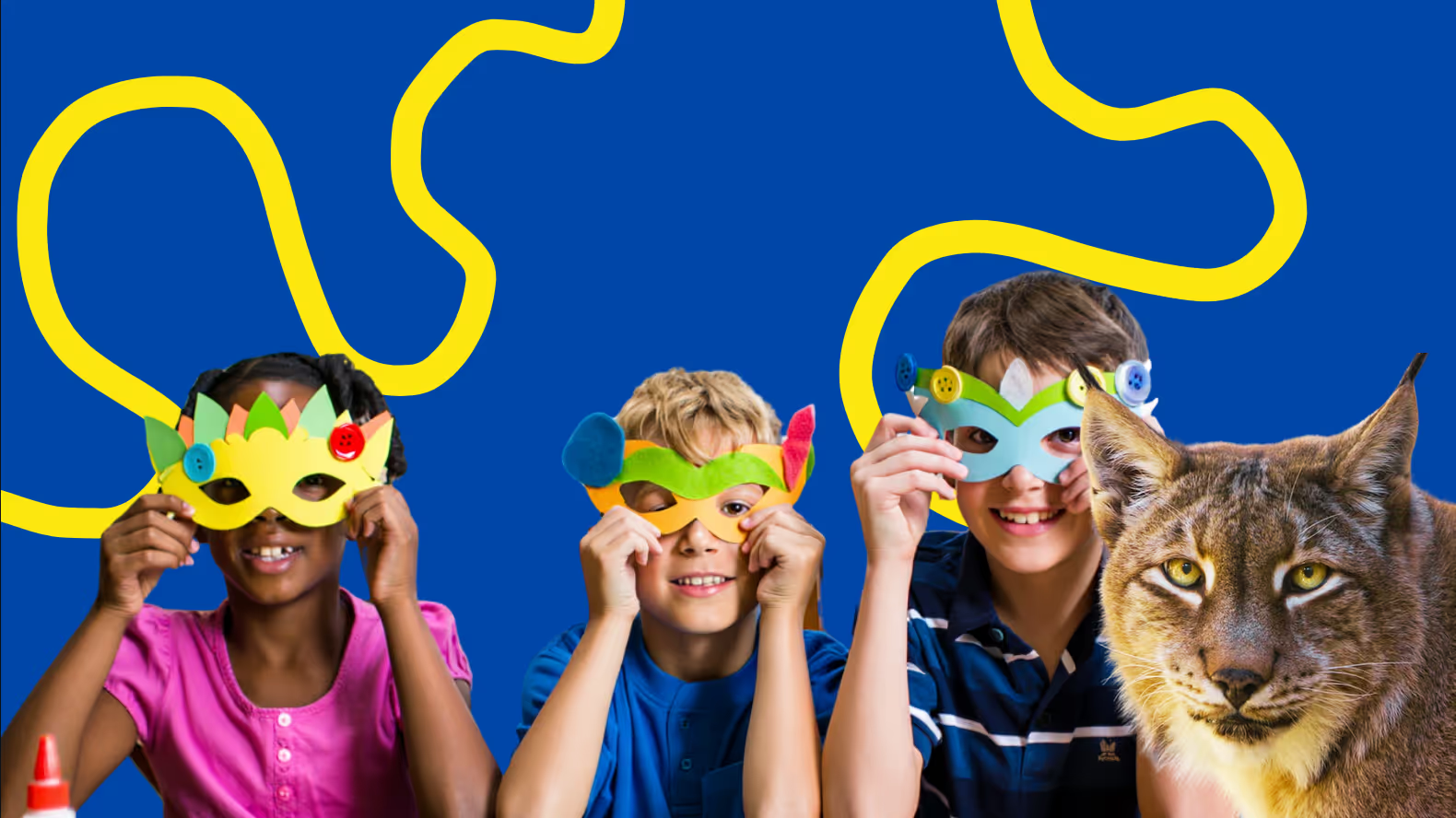
When it comes to learning at home, there are as many approaches as there are colors in the rainbow. So, how do you choose the right curriculum for your kiddo?
The best homeschool curriculum for your child can be the key to a meaningful, deeply engaging education that nurtures their curiosity and challenges them to grow academically, emotionally, and socially, without leaving you exhausted or second-guessing. On the other hand, some curriculum programs might miss the mark when it comes to what your child and your family actually need.
In this article, we explore what makes a homeschool curriculum truly work both in theory and in real life. You’ll learn what to look for in a program so you can choose a learning pathway that fits your family’s needs, as well as your hopes and priorities.
What makes a homeschool curriculum the “best”?
It’s tempting to search for a top-10 list online and call it a day. But the truth is, the best homeschool curriculum depends entirely on your family. Your child’s personality, your household rhythm, and the level of support you want all play a role.
Many families choose homeschooling to better support their child's learning style. Some kids thrive with hands-on activities. Others prefer quiet reading, visual tools, or interactive tech. Some need close guidance, while others crave independence. Families often appreciate the freedom to move beyond grade levels, allowing their child to soar ahead in one subject while slowing down in another.
But here’s where many parents get stuck: the search for a “perfect” curriculum. It’s easy to assume there’s a single solution that'll check every box, solve every problem, and work for every child. In reality, the goal isn’t to find the most popular curriculum. It’s to find one that aligns with your goals, your energy, and your child’s needs right now.
A great homeschool curriculum fits into your life, not the other way around. That might mean:
- Designing a school day that works for working parents
- Navigating life across multiple time zones
- Supporting a neurodiverse learner in a way that builds confidence
- Aligning with family values: whether that’s faith-based, secular, tech-forward, or nature-based
And it’s not just about content. It’s about connection. How does your child feel when they sit down to learn? How do you feel about managing it all?
You also may need to redefine what success looks like. Is it about academic performance? A love of learning? Emotional confidence? These are all valid metrics. What matters is identifying which ones are most important to your family.
Common misconception: Many parents think they need to find the “best” curriculum the first time around. But most homeschool families tweak, change, or evolve their approach over time. What's an excellent choice now might shift as your child grows or as your lifestyle changes.
Curriculum vs. program
Understanding the difference between a homeschool curriculum and a program is where the search can get confusing.
A homeschool curriculum usually refers to content like books, worksheets, lesson plans, or online materials. It’s the what.
A homeschool program offers the full experience. It’s a comprehensive curriculum, complete with instruction, pacing, assessments, teacher or peer interaction, and accreditation. It’s the what, how, and with whom.
Many families start with a curriculum and later realize they need more structure, feedback, or community. That’s when programs start to make more sense. Especially if parents are juggling work, caregiving, or simply don’t want to play teacher every day.
Top priorities when choosing a homeschool curriculum
You might start diving into the educational philosophy when looking at curriculum options for your child. There’s Charlotte Mason’s teaching philosophy, which centers on living books, nature study, and gentle structure. There’s also Waldorf, which takes a holistic approach to learning, and the Reggio Emilia approach, which encourages children to participate in their learning journey.
Other curricula options might blend elements of these well-known teaching approaches, along with more modern elements, like project-based learning, life skills, and social-emotional learning, giving kids a well-rounded education designed to prepare them for the future.
But choosing a curriculum or program involves more than educational style. Instead of starting with a philosophy, there are a few practical elements you’ll want to nail down first.
Flexibility and structure
Some families leave traditional public schools because they feel too rigid. Others leave because it isn’t structured enough. The sweet spot? A curriculum that offers rhythm and breathing room. Where learners feel supported, but not boxed in.
It’s not just about scheduling flexibility, though that helps. A strong homeschool program allows kids to pursue passions at their own pace without falling behind in essential areas. And it gives parents a roadmap without locking them into a rigid path.
What might a week look like? For some families, Mondays start with math workbooks at the kitchen table, followed by a read-aloud under a blanket fort. Tuesday might include a science experiment with baking soda, then a nature walk to collect leaves for an art project. On Wednesday, a parent might lead a mini geography lesson using maps and puzzles, while Thursday includes journaling and a documentary about space. Fridays wrap up with creative projects, baking, or a library visit.
For elementary students, structure can look like short bursts of learning mixed with hands-on activities, movement, and unstructured exploration.
For middle school students, curriculum needs often shift. They’re looking for a challenge and a bit more independent practice without losing support. This could come in the form of higher-level math, foreign languages, or complex science projects. Kids this age can also become disengaged if work is too difficult or doesn’t interest them, which is why bringing in real-world applications can make a world of difference.
A solid homeschool curriculum is not rigid, but it’s not aimless either. When structure meets curiosity, learning flows and brings lessons to life.
Live vs. Pre-recorded vs. DIY
Homeschooling formats usually fall into three types:
- DIY/Parent-led: Full control, but all planning and teaching fall to you
- Pre-recorded/Asynchronous: Watch-anytime lessons, great for flexibility but may lack interaction
- Live Instruction: Real-time teaching online from educators, with structure and engagement built in
Each has its pros and cons. DIY gives you freedom, but it can be time-consuming. Pre-recorded options offer convenience, but feedback might be lacking. Live classes can be the best of both formats, especially for learners who thrive on interaction and discussion.
Support for parents
Homeschooling often turns parents into planners, teachers, tech support, and emotional coaches. The best programs don’t just support learners. They support you, too. For the highest support, look for programs with:
- Feedback on your child’s progress
- Teacher access or coaching
- Parent communities or live help when needed
- Clear documentation and scheduling tools
If you’re trying to homeschool while working — or while managing multiple children — support isn’t a luxury. It’s a must.
At bina, for example, support looks like ongoing communication from your child’s teacher, personalized updates, and proactive insight into emotional well-being. It's more than just academic milestones.
Socialization and real connection
Kids need connection just as much as academics. Strong programs build in collaboration, group work, discussions, and shared experiences. Whether through virtual classrooms, meet-ups, or projects, the best homeschool programs make sure kids don’t feel alone.
Look for programs that improve communication skills, like live peer interaction or real-time project-based learning. Bonus if they embed social-emotional learning and teach collaboration, not just content.
Curriculum scope and depth
You want more than a check-the-box program. Great curricula let kids explore what they love, dig deeper into questions that excite them, and build skills that matter. Think creativity, critical thinking, and emotional growth.
Ask yourself: Will this program challenge my learner? Will it allow them to follow curiosity? And does it build in space to revisit tough topics in a new way?
Here’s an example: a child interested in volcanoes might start with a science lesson, then build a model, research Pompeii for history, and write a fictional story from a survivor’s perspective. Depth isn’t just academic, it’s personal.
Accreditation and global recognition
If you might move in the near future, re-enter traditional school, or apply to a university later, look for accredited programs. Accreditation ensures the curriculum meets certain standards, which helps with smooth transitions across systems and borders.
Be sure to check your country’s or region’s homeschooling laws and how your chosen program fits into them.
What if the best homeschool program isn’t technically homeschool?
Some families want the freedom of homeschooling but without the pressure to teach, plan, or go it alone. That’s where a virtual school like bina offers something different.
bina is a full-time, internationally accredited online school that combines the best parts of homeschooling (flexibility, personalization, and home-based learning) with the structure and connection of a supported school environment.
What makes it different?
- Live daily classes taught by expert educators who tailor instruction to your child’s needs in real time
- Small group sizes (max 8 learners) that promote peer connection and individualized attention
- Social-emotional learning integrated into lessons, not added as an afterthought
- Global classrooms, where learners collaborate across cultures and time zones
- Movement and hands-on learning that balances screen time with real-world experiences
- Progress tracking through ongoing assessments, project feedback, and real-time observations
- Parent-teacher communication that keeps you informed and involved
- Differentiated instruction that meets your learner where they are
A typical bina week might include live math and reading lessons in the morning, followed by a science experiment on Tuesday, a group art project on Wednesday, and a storytelling activity on Friday. All of this is done in a predictable way that still allows for curiosity.
In other words, bina handles the academics like language arts, math, and science, while you get to focus on being the parent.
This isn’t just about convenience. For many families, it’s the difference between feeling overwhelmed and feeling supported.
Enrollment is open year-round, and families can join from anywhere.
How to decide what’s right for you
Wherever you are in your homeschool journey (starting fresh or looking for something more sustainable), it’s okay to pause and reassess what’s working. There’s no single roadmap that works for everyone's learning styles. But there are clues to help you find a fit.
If your child shuts down with worksheets but lights up during creative play, you may want a curriculum that emphasizes project-based learning and interactive activities. If your family moves often, you may need consistency and accreditation. If your days feel chaotic, a clear, structured approach might bring peace of mind.
If you’re looking for:
- An academically strong and emotionally supportive learning environment
- Structure without having to take on the teacher's role
- A consistent, high-quality experience — even if you move internationally
- A learning approach rooted in curiosity, creativity, and connection
…then a full-time virtual school may be exactly what your family needs right now.
Still not sure? Start by noticing how your child learns best and what’s been hardest about past experiences. From there, the right path becomes clearer.
The best curriculum is the one that works
There’s no single “best homeschool curriculum.” But there's one that fits your learner, your goals, and your daily rhythm.
The right fit helps your child grow without leaving you exhausted or second-guessing. It offers support, flexibility, and peace of mind.
Want to explore if bina is right for your family?
FAQs
How many hours a day should a child homeschool?
It depends on your child’s age and the structure of your program. Most homeschool days are shorter than traditional school days, especially in the early years. Some regions have specific guidelines. At bina, learners attend about five hours of live class each day with time built in for movement, breaks, and creativity.
What percentage of kids are homeschooled?
In the US, more than 3.1 million children are currently homeschooled. Globally, the number is rising as more families seek flexible, personalized, and values-aligned education.
Is there a curriculum that’s best for neurodiverse learners?
There’s no single best fit. But the most effective programs offer flexibility, personalized pacing, and strong emotional support. Small-group instruction, consistent feedback, and teachers who understand diverse learning profiles can make a big difference.
What's the most successful homeschool method?
There’s no one-size-fits-all answer. Popular approaches like Charlotte Mason, Montessori, classical education, and unschooling each have strengths. Success depends on how well the method aligns with your child’s needs and your family’s lifestyle.
What's the most-used curriculum in the world?
Globally recognized programs include the International Baccalaureate (IB), British curriculum, and Common Core-aligned resources. But popularity doesn’t always equal fit. What matters most is what works for your learner.
What's the easiest homeschool curriculum?
For many families, the easiest curriculum is one that doesn’t require them to plan or teach formal lessons. Programs like bina take care of the academics, so you can focus on being the parent — not the full-time educator.
Accredited, full-time school for grades K-12
Bring the best of the classroom to your home
See if we're a fit

More to read

A parent’s guide to homeschool social studies curriculum
Explore homeschool social studies curriculum options that make big concepts approachable. Access resources and learn about the bina approach.


Picking a homeschool online reading program for your child
Learn how to choose the best online homeschool reading program, with popular options, common pitfalls, and a look at bina’s unique approach.

The best 6 online accredited homeschool programs in Texas
Explore the best accredited online homeschool programs in Texas, with tips to choose the right fit for your child and family.