Everything you need to know about 5th-grade homeschool curriculum

Somewhere between “still a kid” and “almost a teenager,” 5th grade shows up with big questions, bigger opinions, and a growing need for independence. Your learner might still love imaginative play one minute and challenge every rule the next.
That’s what makes this stage so unique. It’s not just the bridge between elementary and middle school. It’s a year where academic skills solidify, emotional shifts begin, and curiosity deepens — often all at once.
Choosing a 5th-grade homeschool curriculum isn’t just about checking subjects off a list. It’s about building a rhythm that honors your child’s complexity: structure without rigidity, challenge without overwhelm, and space for the kind of learning that actually sticks.
Because at this age, your learner isn’t just growing up. They’re growing into themselves.
Why 5th-grade learners need something different
By age 10 or 11, many learners are in a season of contrast. They can work independently but still need reassurance. They want to belong but crave individuality. They’re curious about the world, but they’re also navigating some real internal shifts.
Socially and emotionally, this is a time of increasing awareness. Friendships deepen and sometimes get more complicated. Peer dynamics evolve, and kids notice how they compare to others. Confidence may waver, and emotions can spike without warning. This is often when learners begin asking for more freedom, just as they quietly crave a structure that still feels safe.
Cognitively, this is when executive functioning skills begin taking root. Learners can hold multiple ideas at once, make connections across subjects, and express more nuanced opinions. Writing evolves beyond basic paragraphs. Math becomes multi-step and conceptual. Reading shifts from fluency to analysis.
It’s also when new learning needs may surface. A learner who flew through early grades might suddenly get stuck on long division or grammar rules. Others might appear disinterested, not out of laziness, but because they want a more meaningful challenge.
This isn’t a failure. It’s growth.
Fifth grade is often the inflection point between instruction and autonomy. The more we notice what’s shifting (and what’s being asked of our kids), the better equipped we are to support them through it.
Subjects to teach in a 5th-grade homeschool curriculum
By 5th grade, learners are expected to stretch their thinking, manage more complex tasks, and deepen their understanding across subjects. But that doesn’t mean it all has to feel heavy.
A great 5th-grade homeschool curriculum blends strong academic foundations with space for curiosity. You’re not just helping your child learn multiplication or write longer essays, you’re helping them build skills that support independence, confidence, and a love of learning.
Let’s take a look at what each subject can look like at this stage.
Language arts
Fifth graders are refining their reading and writing skills. They’re reading longer chapter books, exploring nonfiction texts, and beginning to analyze character motivations, themes, and cause-and-effect relationships. Reading aloud still matters. But now your learner is just as likely to read independently and start a debate over a character’s choices.
Writing becomes more expressive and structured. Learners write multi-paragraph essays, opinion pieces, personal narratives, and short stories. Grammar instruction also starts to click, especially when it’s modeled clearly and applied in context. This is a good year to reinforce punctuation rules, sentence variety, paragraph structure, and transition words through both direct instruction and editing practice.
Book choices at this age should reflect a range of voices and perspectives. Mix in both fiction and nonfiction and revisit favorites for a deeper discussion. Encourage journaling or response writing that gives your learner space to form opinions and make connections.
Math
Fifth-grade math goes beyond basic operations. Learners are practicing multi-digit multiplication, long division, fractions, and decimals. They might also begin exploring geometry and working on measurement conversions.
Visual tools like number lines and manipulatives can still make a big difference, especially when introducing abstract ideas. This is a great year to introduce logic puzzles, budgeting projects, or recipe conversions to keep math grounded in real life. Learners can use math to track a savings goal, adjust a baking recipe, or plan a trip, helping them see it as useful and relevant.
Balance structured practice with exploration. A weekly rhythm might include a few days of core lessons, one day for math games or digital platforms, and one day for an applied project. Focus on persistence and flexible thinking, not just memorization.
Science
By 5th grade, kids want to know how the world works, and they’re ready to dive deeper into science topics. This is an ideal time to explore ecosystems, energy, the water cycle, weather, simple machines, and human body systems. Encourage open-ended questions, predictions, and hands-on learning.
Try projects like a weather journal, plant growth experiments, or a homemade Rube Goldberg machine so your kiddo can build and experience their own chain reaction.
This is also the age to connect local learning to global thinking. Compare ecosystems across continents or track weather data between regions. At bina, lessons like these often tie into the UN’s Sustainable Development Goals — encouraging learners to explore their impact and see themselves as changemakers.
Social studies / history / geography
At this grade level, kids are ready to zoom out and see how people, cultures, and systems fit together. Whether your country introduces national history or global studies this year, learners benefit from understanding maps, landforms, government systems, and how people live differently around the world.
Use storytelling to help concepts stick. Read biographies, explore your family history, and connect with other homeschoolers in different regions.
Make room for current events and guided discussion. Learners in 5th grade are forming opinions and developing empathy. Help them understand how events and systems affect real people — and why that matters.
Creative learning and life skills
Creative expression and real-world learning aren’t just add-ons. They’re core to helping 5th graders feel capable and connected. This is the year to build emotional resilience and confidence through the arts, hands-on projects, and everyday responsibilities.
Include opportunities for music, storytelling, drama, or visual arts. Try activities like creating a short play, composing a song, or illustrating a comic book version of a history topic. Activities like LEGO builds or baking mix logic and fun.
5th-grade homeschool curriculum resources
Here are helpful resources you can use to build an engaging curriculum for your 5th-grade homeschooler.
- Freedom Homeschooling provides a great reading list for 5th-graders.
- NovelWise offers printable worksheets to help kids analyze the books they’re reading.
- Daily Grammar has free grammar lessons and quizzes.
- Khan Academy has a complete 5th-grade math curriculum, with video lessons, practice problems, and tests.
- Mystery Science provides video lessons, directions, and printouts for hands-on science activities that are designed for 3rd to 5th graders.
- Generation Genius has video-based lessons for both math and science.
- National Geographic Education is a rich source of articles, videos, and activities to help kids learn more about the world.
- PBS Learning Media offers free grade-level content on world history and current events.
- Tools like code.org and Scratch help learners explore digital creativity and develop coding skills.
What does a day look like in 5th grade?
In a homeschool setting, your day doesn’t need to follow a school bell schedule. But it does need to work for your child’s learning style and your life.
Some days will move quickly; others might stretch as you follow a question, detour into a project, or take more time with a tough concept. That’s part of the beauty of personalized learning at home: you can adjust the pace without losing progress.
Many 5th-grade homeschoolers start the day with core subjects like language arts, math, and science before shifting into more flexible or creative work in the afternoon. That might mean a hands-on project, a nature walk, a deep-dive research topic, or even an online language class with kids from around the world.
Tips for building the right 5th-grade curriculum for your child
Giving your learner a say in how the day flows builds both confidence and motivation. Let them choose between writing first or math first. Let them co-create a simple checklist. Invite them to share what worked (or didn’t) at the end of the day.
By 5th grade, kids are ready to start building life skills like goal-setting, time management, and personal responsibility. Let your child help plan the weekly schedule or take charge of a research project. These experiences help learners feel trusted, motivated, and more connected to their education.
Fifth graders are no longer just participating in their education. They’re beginning to shape it. The most effective homeschool curriculum grows with them by offering choices that build ownership, such as picking a new science topic or spending extra time on creative writing. These early sparks of interest can shape future classes, hobbies, or even careers.
As a parent, you’re not just tracking what works. You’re helping design an experience that reflects your learner’s growing voice. So when you see a spark of curiosity or a sign of resistance, ask:
What can we adjust? What can we explore next, together?
That might look like:
- Swapping a rigid workbook for a more interactive platform or hands-on project
- Letting your learner propose a short-term “passion project” to pursue alongside core subjects
- Reflecting on the week together: what felt energizing, what felt stuck, and why?
When learners feel seen and included in shaping their experience, they don’t just stay on track, they take ownership of the journey.
At bina, that’s the heart of how we teach. With trained educators, small class sizes, and ongoing adaptation, every 5th grader is supported in a way that fits them. That’s what we call precision education, an approach that balances standardization and personalization.
Every day of homeschool doesn’t have to be perfect. But when your child feels seen, supported, and involved in the process, learning tends to stick — because it feels like it belongs to them.
What if you’re not sure about building a 5th-grade homeschool curriculum alone?
By 5th grade, many homeschool families have found a rhythm, but that doesn’t always mean it’s sustainable.
Maybe you’re stretched thin managing lessons, logistics, and life. Maybe your learner is ready for deeper challenges, more peer interaction, or feedback that doesn’t rely solely on you. Or maybe the spark is fading, and what once felt joyful now feels like a daily uphill climb.
That’s where a full-time online school like bina comes in.
bina isn’t a curriculum to piece together or an app to manage on your own. It’s a globally accredited, teacher-led school built for families who want home-based learning, with professional support baked in.
In our small, live classes (capped at eight learners), your child is guided by trained educators who specialize in both academic rigor and emotional well-being. And because students show up for a full, connected day alongside the same peers and teachers, real relationships take root.
At bina, learners at this age experience:
- Live, daily instruction in reading, math, science, social studies, and more
- STEAM (science, technology, engineering, arts, and mathematics) and interdisciplinary projects that encourage global awareness and real-world problem-solving
- Classmates from around the world, offering new perspectives
As a parent, you stay in the loop, but you’re no longer carrying it all. If your family is ready for a program that feels as personal as homeschooling but comes with a team behind it, bina could be the right fit.
Making 5th grade fit your learner
Fifth grade isn’t just the tail end of elementary school. It’s the year your learner begins to take ownership of their thoughts, their routines, and the way they see the world.
That’s why your 5th-grade homeschool curriculum should be more than a checklist. It should help your child grow. Not just academically, but as a thinker, a friend, and a human being.
Whether you build your own plan or find a full-time program that fits your family, the goal stays the same: to support your child in becoming more confident, capable, and connected to what they’re learning.
At bina, that’s what we’re built for. With live classes, small peer groups, experienced teachers, and a globally accredited curriculum, we help 5th graders thrive.
Accredited, full-time school for grades K-12
Bring the best of the classroom to your home
See if we're a fit

More to read
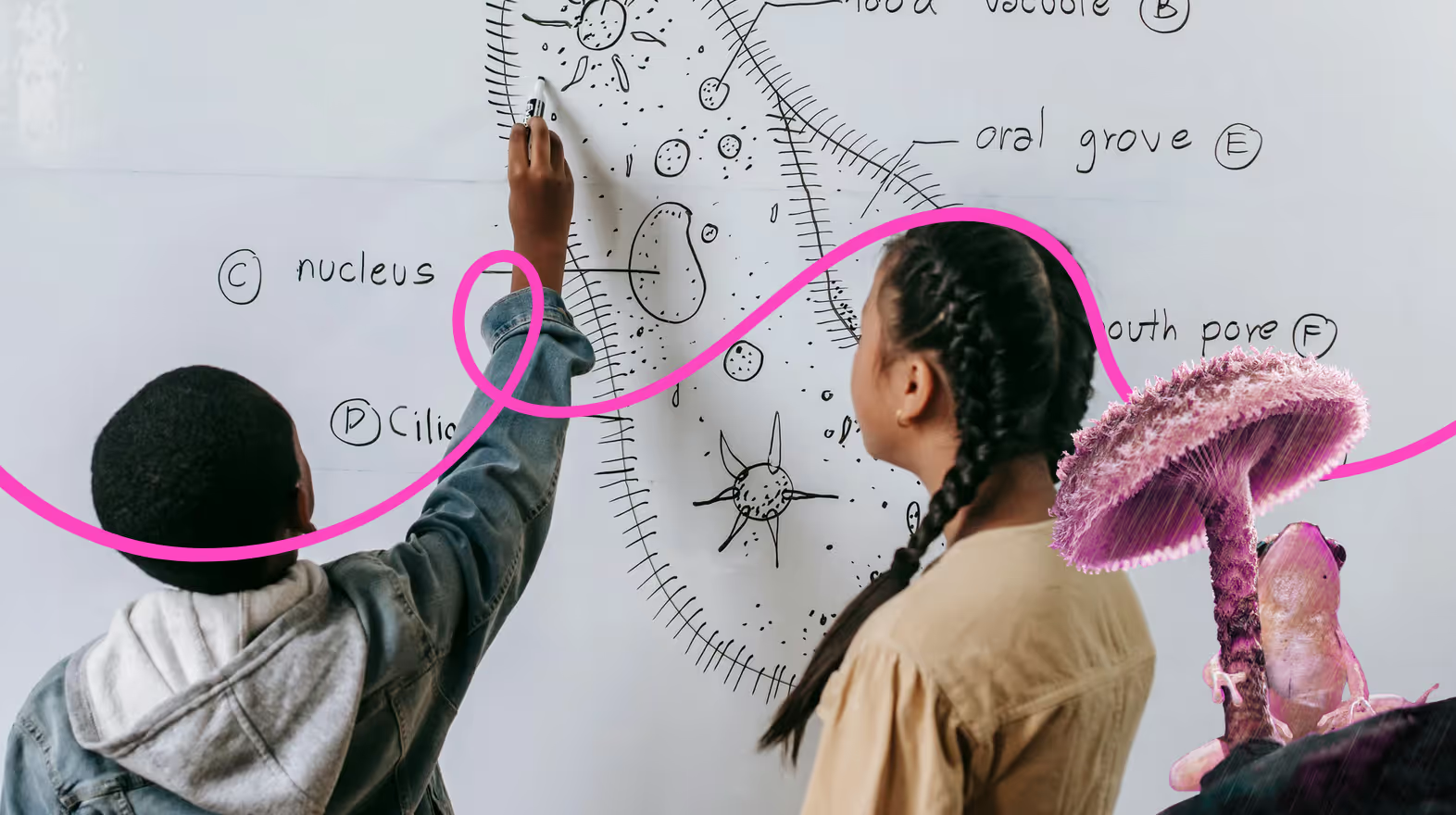
Everything you need to know about 6th-grade homeschool curriculum
Discover what makes a great 6th-grade homeschool curriculum and how to create a structure that supports academic growth, independence, and joy.

Everything you need to know about 4th-grade homeschool curriculum
Discover how to build a 4th-grade homeschool curriculum that sparks curiosity. Learn what to teach, how to adapt, and where support makes a difference.
Everything you need to know about 3rd-grade homeschool curriculum
Create the ideal homeschool curriculum for your 3rd grader. Learn essential subjects, tips, and curriculum choices. Start planning today.